
14 Oct 2024 | 3 min read
A recent J.D. Power study highlighted that customer loyalty in the car rental industry is deeply connected to trust. Companies that communicate clearly with customers and provide seamless, reliable service are able to foster loyalty more effectively. The study underscores that trust is earned through transparency and simplicity, elements that are increasingly expected by customers in today’s digital world.
At 2hire, we offer solutions designed to meet these modern customer expectations. Our connected technology enables car rental companies to provide a streamlined, fully digital experience that boosts both operational efficiency and customer satisfaction.
Our keyless, fully contactless pick-up and return system eliminates the need for customers to wait at the desk, providing a faster, more convenient experience. Rental companies using 2hire’s technology can offer customers the flexibility to pick up and drop off vehicles at any time. This not only improves the customer experience but also builds trust by ensuring that every step is transparent and reliable.
The future of mobility is undergoing a rapid transformation, and car rental companies are uniquely positioned to be at the forefront of this exciting evolution. As customer expectations shift towards more on-demand, flexible, and hassle-free services, rental companies have the opportunity to redefine what mobility means. No longer just about providing a vehicle for a few days, car rentals are becoming a cornerstone of smart, sustainable urban transportation, bridging the gap between ownership and ride-sharing.
By embracing digital tools, like contactless pick-up and return, and harnessing the power of real-time vehicle monitoring, car rental companies can not only streamline their operations but also deliver a superior, tailored experience that today’s customers crave. Imagine a world where renting a car is as easy and seamless as ordering a coffee, where every interaction is efficient, transparent, and satisfying. This is the reality that 2hire is helping to create!
But it doesn’t stop there. Car rentals will also play a key role in the larger picture of mobility as a service (MaaS), offering dynamic, adaptable solutions that cater to the growing demand for short-term, sustainable transport options. Whether it’s providing vehicles for a quick weekend getaway or as part of a corporate fleet, the ability to integrate digital solutions like 2hire means that rental companies can remain agile and responsive in a rapidly changing market.
In our previous articles, such as “How to Choose the Right Connected Car Partner” and “Can a Classic Car Sharing Solution Be Applied to the Digitalization of a Car Rental Fleet?”, we’ve explored how innovative connected solutions are already reshaping the industry. Now is the time to embrace this shift and lead the charge in defining the next era of mobility.
Posted on October 14, 2024 by Benedetta Biggi
27 Aug 2024 | 3 min read
In the ever-evolving landscape of telematics and connected vehicle services, traditional solutions are increasingly proving inadequate for the dynamic needs and diverse use cases of short-term car rentals. The economics of outdated telematics systems often fail to deliver a return on investment, making it crucial to adopt a more holistic and flexible approach.
The bar is higher today to truly empower your organization to be at the forefront of the mobility revolution. In this market environment, you need to innovate in fleet management, cost reduction, and operational efficiency to truly make the most out of your assets. At the same time, you can’t avoid planning to increase the value offered and captured. You are probably in the process of developing new products and services to delight your customers through superior customer service and digital experience.
As an ambitious short term car rental leader, you should think about truly mastering the following key use cases – which are simply not possible without a complete and reliable connected fleet solution:
Keep control of the fleet through real-time monitoring for stolen vehicle recovery. Set up geofences and alerts to know when a car is close to or accessing unsafe zones. Prevent theft, and when it happens immediately recover all your vehicles to save big every year.
Leverage automated fuel and mileage data update at each pickup / dropoff. Automate extra charges for fuel and mileage. Get paid for all the fuel effectively used by the customer by leveraging precise fuel level measurement.
Keep your fleet health status under control through real-time alerts on battery voltage, engine faults, and tire pressures. Avoid breakdowns and idle times.
Set up skip-the-counter solutions to cut costs, increase rentals, and provide a great customer experience. Allow your customers to rent 24/7, skip the queues, unlock the car via smartphone, and return any time. Offer new premium packages, unlock revenue streams, and boost your brand.
All this should be planned while keeping laser focus on the health and growth of your day-to-day business. Challenging, right?
Add on top that the increasing proliferation and fragmentation of telematics solutions and connected vehicle platforms make it a nightmare to trigger the flywheel of connected mobility value.
Navigating these complexities requires a strategic approach to selecting the right partners. You should choose a Connected Vehicle Partner who can master the orchestration of hardware and software, aftermarket telematics and OEM connections, data and remote interactions, APIs and dashboards. A robust solution should merge top-tier aftermarket hardware with OEM fleet data APIs into a reliable, fully-integrated service package that smoothly integrates the data and functions you need, where you need them.
And which are the factors to be considered when evaluating your Connected Vehicle Partner?
Posted on August 27, 2024 by Benedetta Biggi
5 Apr 2024 | 4 min read
Among the many innovations currently transforming the car rental industry, connectivity to cars emerges as a key element in redefining the way cars are rented, managed, and used. In an increasingly connected world, where digitization drives change in every sector, telematics offers tremendous potential to improve the customer experience, optimize operations and open up new business opportunities.
Some companies are embracing this type of technology, but there is plenty of room for growth, and today we will address how 2hire solution is the ultimate combination between reliability, efficiency and quick scalability for any car rental fleet.
Telematics is now an integral part of any digitization strategy for car rental fleets. However, not all telematics solutions lend themselves easily to fleets.
Fleet rotation in a car rental company refers to the practice of regularly replacing cars in the inventory with new vehicles. This process is aimed at several objectives, including maintaining a modern and reliable fleet, offering customers the latest technologies and features, maximizing the residual value of cars, and effectively managing operating costs.
Rental companies usually maintain a regular turnover of their car fleet. This rotation may vary from company to company, but it usually involves selling or retiring older cars and adding new models to ensure that the fleet is always competitive in the car rental market.
Regular fleet rotation allows rental companies to perform regular fleet checks and preventive maintenance on cars. This helps reduce the risk of unexpected breakdowns and ensures that cars are safe and reliable for customers.
Rental companies often update their fleet with newer models to offer customers the latest technology and comfort.
Fleet turnover can also be influenced by market demand and seasonal variations. For example, during peak periods tourist demand is at its maximum, and rental companies may increase their fleet to meet demand, while during low periods the demand is less and they may reduce it to avoid overcapacity.
So here we are, can a classic car sharing solution be applied to the digitization of a car rental fleet?
Considering the intensity of operations revolving around fleet rotation, we decided to break down some key reasons why this is not feasible with just a carsharing solution but a more comprehensive solution, such as 2hire one, is the best.
2hire solution is tailored to the wants and needs of a rental company that wants to digitize, and here we explain why.
Many telematics devices take hours to install and launch on the market. The device setup process itself is also very often long and cumbersome. The necessary installation time of some solutions inevitably becomes a difficult lever for companies that want to connect their fleet in a short time and scale up quickly. The cars in the fleet cannot sit idle waiting to be installed without immediate action, the stalling of cars and consequent stop of rentals would cause a huge loss of revenue that rental companies cannot and don’t want to deal with.
Devices available on the market are very often complex and invasive to install, which is why a professional installer is needed to install them in every vehicle. The installer itself has a cost for each installation requested and works according to its availability cross-checked with the availability of cars.
Not an easy combination.
The only alternative would be to take the car to a workshop or opt to ‘sacrifice’ the vehicle’s physical key to facilitate installation. A risky and expensive choice.
Moreover, at every infleeting and defleeting cycle the procedure would be repeated both in terms of time and cost, the setup would be rerun causing operational disruption to the business and significant revenue loss.
A not easily scalable strategy for large fleets!
Even though the world is increasingly moving towards a software-oriented approach in which connected vehicles are projected to be 95% of the total by 2030, the car rental market is still very much looking for hardware solutions for its non-natively connected vehicles. Although it may seem like outdated reasoning for modern times, today’s car rental has many more non-connected cars than connected ones, so it strongly needs a hardware solution to support the digitization of its fleet, today’s needs require this and 2hire is the most in-line player to fulfill this need.
The telematics solution offered by 2hire goes against the grain. It does so by leveraging: speed of installation, ease of installation, reconfiguration without constraints, and straightforward scalability.
2hire solution gets installed in 10 minutes. No need for professional personnel to install the devices, but rather a quick initial training directly provided by 2hire to kick-start the installations fully autonomously.
Considering vehicles’ rotation in a fleet, 2hire’s device can be quickly reconfigured, ready to be conveniently reinstalled on any other vehicle in the fleet.
2hire’s solution has as an asset a radical scalability over large volumes, from small to medium-sized fleets up to large fleets with thousands of vehicles.
2hire is the only ad hoc player to digitize rental in a radical and scalable way, making it a highly profitable, intuitive, and fast business by having a device that can be easily reconfigured and quickly reinstalled on any other vehicle.
Digitisation is made easy at 360 degrees, with 2hire technology. We will make a quick switch off of the 2hire devices and an immediate switch on of car embedded connectivity, the integration will be exactly the same with no further effort required.
Curious to know more about the topic? Stay tuned for the next episode and follow us on LinkedIn to be updated on how 2hire helps car rental companies on the path towards digitization.
Digital Content and PR Specialist at 2hire
I love running and daydreaming losing count of the distance I’m covering, cooking (and especially eating) and Drake is my spirit guide.
Posted on April 3, 2024 by Benedetta Biggi
29 Feb 2024 | 4 min read
In previous episodes we’ve talked about how the need for convenience is the core around which rental companies are innovating. Keyless technology is reshaping the way people rent vehicles and in this article we will cut this to the chase without too many frills.
The ongoing challenge of customer experience within the car rental sector is widely acknowledged. Following a report by J.D. Power, rental car customer satisfaction remained at record low levels as of early 2022. As a sector, car rental consistently has the lowest NPS score, way below health insurance and even airlines, symbolizing a significant need for innovation.
Let’s dive into the clear differentiation between traditional key-based rentals versus 2hire keyless solution and how 2hire is helping car rental businesses to boost income and optimize operational costs.
Securing a rental car keeps entailing the arduous task of queuing up in winding lines at rental counters. This issue presents a formidable barrier between eager customers and their desired mode of transportation. For travelers, particularly those coming from long flights or journeys, the prospect of standing in line for a long time is not only inconvenient but also exasperating.
The inefficiencies of the rental counter process compound the issue, exacerbating delays and customer dissatisfaction. Rental agents, inundated with paperwork and administrative tasks, are struggling to keep pace with the demand, resulting in prolonged wait times.
Beyond the inconvenience, the need to stand in line at rental counters represents a lost opportunity for both customers and rental companies. Customers, eager to maximize their time and make the most of their travel experiences, find themselves held captive by the rigidity of the traditional rental process. Meanwhile, rental companies, constrained by outdated procedures, risk dissatisfied customers and losing out on potential business.
With 2hire keyless solution, renters are empowered to bypass the rental counter entirely, liberating them from long waiting times..
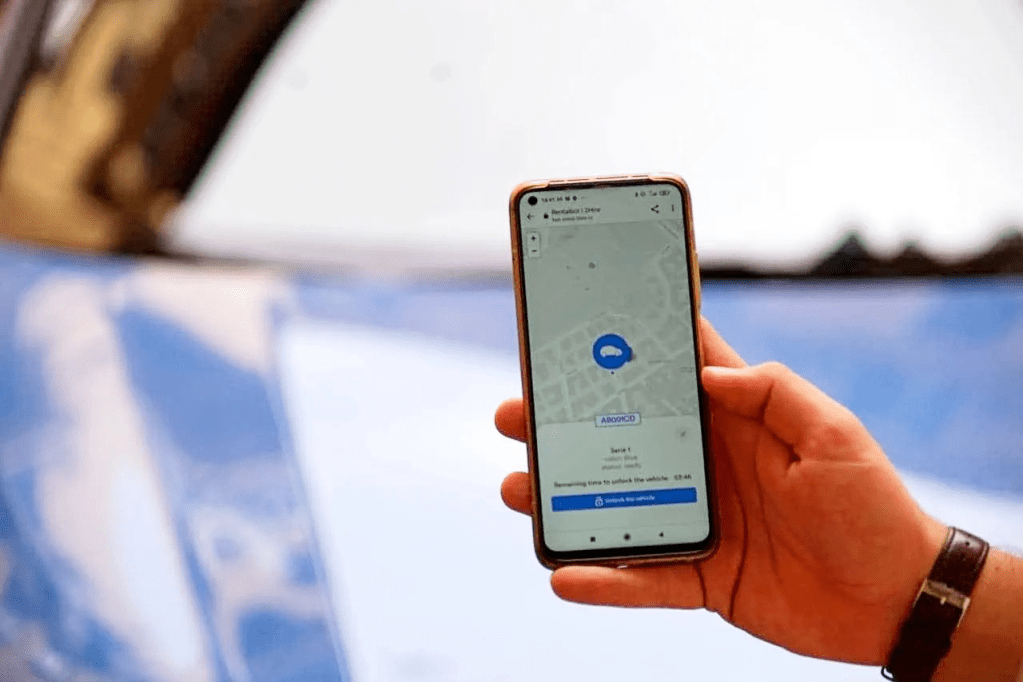
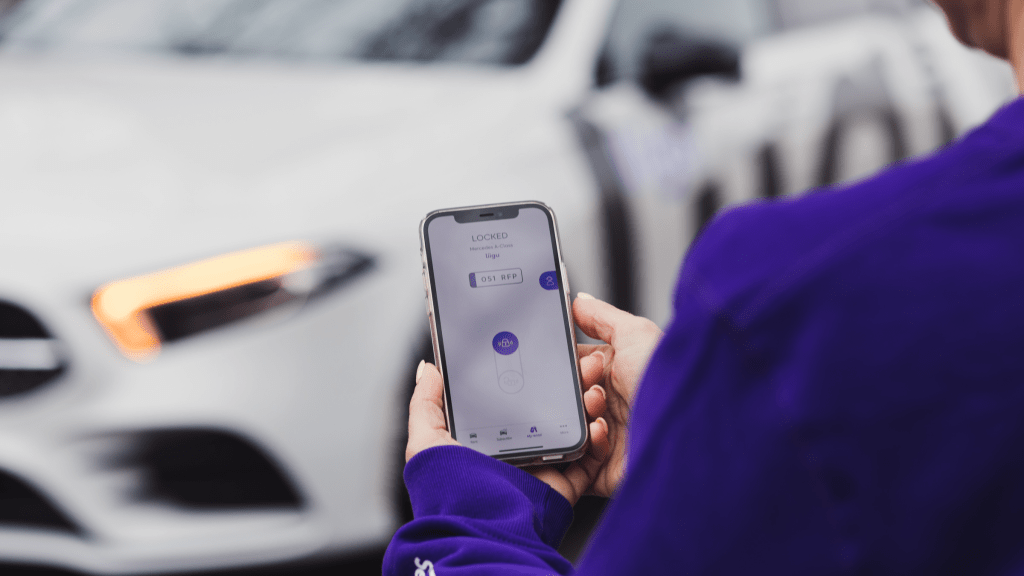
2hire keyless solution brings renters the convenience of a seamless and expedited rental experience, all at their fingertips. Through mobile access to the car, renters gain direct access to their chosen vehicle without the need for physical keys or intermediary interactions. The renting tourist visiting the city with family can receive a link on the phone to locate the vehicle, unlock the car doors and start the journey right away. In the same way, at the end of the rental it can just leave the car keys secured in the car, lock the car via phone, and leave…Long waiting times and dull paperwork are just a far-off memory!
When a customer makes a reservation, traditional car rental companies manually allocate a vehicle from their fleet based on availability and reservation details. This allocation process often involves hardworking access to the central reservation system or database to check vehicle availability and assign a specific car to the reservation.
With traditional key-based rental processes, physical keys are issued to customers upon vehicle pickup. Rental staff manually retrieve keys from a designated key storage area or cabinet and hand them over to customers along with the necessary paperwork. Keys are typically attached to a tag or keychain that identifies the vehicle they belong to.
With 2hire solution, reservation and allocation become more efficient and streamlined. Instead of manually allocating vehicles based on availability, rental companies can utilize automated systems that integrate with their fleet management software. Keyless allows for real-time tracking of vehicle availability and status, enabling rental companies to optimize their fleet allocation process and ensure that vehicles are assigned to reservations promptly. This reduces the likelihood of overbooking or discrepancies in vehicle availability, leading to a smoother and more seamless rental experience for customers.
For key handover the simplicity is the same. Instead of issuing physical keys to customers upon vehicle pickup, rental companies can utilize 2hire keyless entry system that allows customers to instantly access the vehicle using their phone. This eliminates the need for rental staff to manually retrieve and hand over keys, reducing wait times and administrative overhead.
In traditional car rental, customers are required to complete extensive paperwork at the rental counter, including rental agreements, insurance forms, and vehicle inspection reports. This part of the process can be time-consuming and often requires customers to provide redundant information that could be streamlined through digital processes.
Rental staff manually verify customer identification, rental agreements, and payment details, which can lead to delays and errors. Each step of the check-in and check-out process requires manual input and validation, increasing the likelihood of mistakes and inconsistencies.
During peak rental periods, rental counters can become crowded, leading to long wait times and frustrated customers. Rental companies may struggle to manage the flow of customers efficiently, resulting in bottlenecks and delays at the check-in and check-out counters.
As previously mentioned, in traditional rentals customers receive physical keys to then proceed with check-in. This requires rental staff to locate the appropriate key, retrieve it from a designated storage area, and hand it over to the customer. Something easily slow, especially during peak rental periods when multiple customers are checking in simultaneously.
With 2hire solution, the process becomes digital. This doesn’t mean control is left aside, but actually is enhanced in a way that makes the renter more free to manage every rental quickly without the stress of letting people on hold while doing so.
2hire keyless entry helps customers save time, as they no longer need to wait for the staff to locate and assign them the physical keys for check-in. Instead customers can access their assigned vehicle autonomously eliminating the time-consuming process of key retrieval and significantly speeding up the check-in process.
Keyless simplifies the vehicle return process too by eliminating the need for customers to return keys to the rental company. Instead, customers can securely lock the vehicle and complete the check-out process digitally, reducing the time spent at the rental counter.
Rental staff can remotely verify the vehicle’s condition and fuel level thanks to data reading. They can view the data collected from the vehicle and review the reported information through the rental company’s backend system. Being able to remotely verify the vehicle’s condition, compare it with the renter’s report, and ensure that it meets the company’s standards for return, streamlining the inspection process and minimizing wait times for customers.
Offering keyless car rental is no longer just a luxury – it’s a necessity. Customers expect fast, convenient, and secure rental experiences, and 2hire keyless technology delivers on all fronts. Rental companies that embrace 2hire keyless solution stand to gain a competitive edge, attracting more customers, boosting income, and gaining market presence.
Digital Content and PR Specialist at 2hire
I love running and daydreaming losing count of the distance I’m covering, cooking (and especially eating) and Drake is my spirit guide.
Posted on February 28, 2024 by Benedetta Biggi
21 Feb 2024 | 4 min read
Peer-to-Peer car sharing Market is expected to grow at a CAGR of over 22% during 2021-2027, reaching USD 5.4 billion by 2028.
Traditional and emerging OEMs are focusing not only on the car rental or car subscription market but also on rising markets within the Peer-to-Peer car sharing industry, considering the exponential interest and vibrant growth this market is showing. For example, there are platforms dedicated to luxury car rentals, vintage and classic cars, and other specialized vehicle types.
These platforms cater to specific customer segments seeking unique and memorable rental experiences.
OEMs are therefore moving from production only to selling services too.
The shared mobility model will offer OEMs an opportunity to focus on another branch and start selling services: one of the most promising sectors today is connected Peer-to-Peer car sharing and Mobility as a Service (MaaS). Within these trends, OEMs will get an opportunity to move into the profitable markets of Peer-to-Peer car sharing and new mobility, leading OEMs to increase their future mobility offerings and capture additional revenues.
Today more than ever, OEMs market dominance will not hinge on providing the most cost-effective vehicles, but rather on delivering cutting-edge technology, an extensive array of digital services, and seamless accessibility to on-demand mobility solutions.
Link & Co is a subsidiary of Geely Auto, a Chinese automotive company known for its ownership of Volvo Cars and other brands.
The brand was officially launched in 2016 with a focus on developing vehicles that are highly connected and tailored for shared mobility solutions. Lynk & Co has adopted a business model that integrates car sales with a subscription and sharing approach. This model has been compared to streaming services such as Netflix, where customers can enjoy a car without physically owning it through a monthly subscription.
The brand is pioneering a car-sharing approach to prioritize the European market expansion and address the inefficiency of traditional car ownership. Through its app, Lynk & Co enables owners to share their vehicles, aiming to maximize car usage and reduce urban congestion. Lynk & Co has established a community centered on Peer-to-Peer car sharing, collecting over 1.5 million hours of shared mobility. Emphasizing sustainability and inclusivity, the company asserts that car sharing transcends being merely a service; it represents a dedication to reshaping car ownership for a more sustainable tomorrow.
Talking about some data insights…
Lynk & Co’s Peer-to-Peer car sharing community is thriving, with lenders earning approx €850,000 in the last 12 months. The program allows subscribers to cover monthly fees through car sharing income. Key statistics include 18,000 car sharing instances, a 136% increase in bookings, and the Netherlands leading in car sharing participation with 22% of owners actively involved. Lenders can set hourly prices, with variations such as 9 €/hour in Sweden and 30 €/hour in Italy.
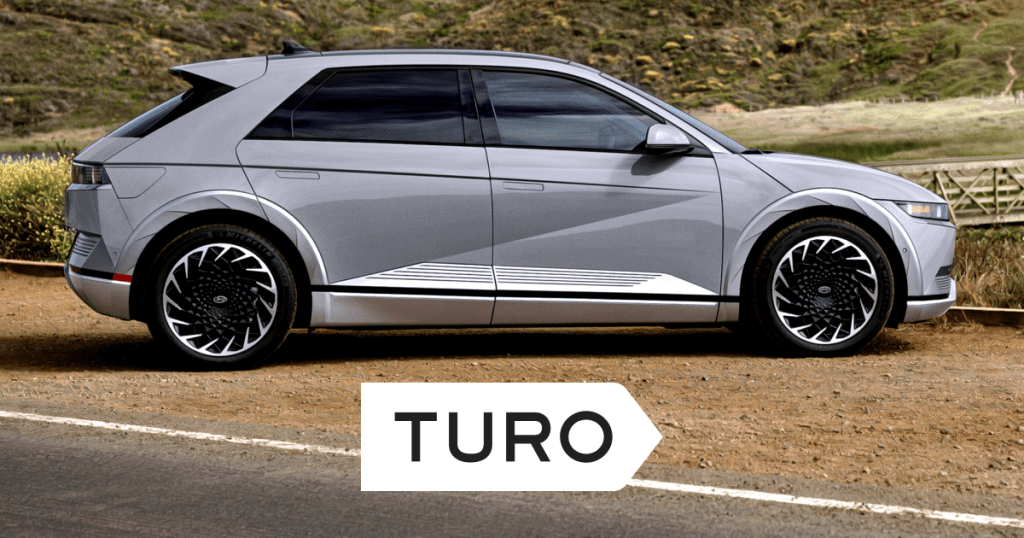
Major OEMs initiated the partnership with Peer-to-Peer car sharing companies in recent years. A core example is the automotive giant Hyundai signing a partnership with Turo to allow hosts to easily make their Hyundai vehicles available for rent through the Turo platform.
The collaboration between Hyundai and Turo wants to unlock an extreme potential into the Peer-to-Peer industry, with the aim to innovate even more the car sharing experience. This collaboration plans to inject a fleet of premium Hyundai vehicles within the Turo marketplace, accompanied by substantial incentives for prospective hosts, totaling up to $5400.
As the Peer-to-Peer car sharing market continues its rapid growth trajectory, emerging OEMs are seizing the opportunity to diversify their business models and tap into this trending sector. By expanding beyond traditional car sales and embracing services like car sharing, OEMs are not only broadening their revenue streams but also enhancing customer engagement and brand visibility. With a focus on innovation, sustainability, and meeting evolving consumer demands, OEMs are poised to play a pivotal role in shaping the future of mobility.
Digital Content and PR Specialist at 2hire
I love running and daydreaming losing count of the distance I’m covering, cooking (and especially eating) and Drake is my spirit guide.
Posted on February 22, 2024 by Benedetta Biggi
15 Feb 2024 | 4 min read
Elevating the role of the customer experience in the contactless car rental process is of utmost importance in today’s rental market. Rentals need to keep up with services such as mobile payments in order to offer people the same speed and convenience when it comes to renting a car.
It’s all about the increasing customer demand for contactless options 💡🛜
We previously said it’s not just about car rental, every service is trying to move closer to a contactless offering in order to remain a leading-edge, every service is trying to move closer to a contactless offering in order to keep pace with evolving customer expectations. Modern customers now value rapidity, convenience, and safety. Contactless fits all these needs perfectly and 2hire connectivity is the secret ingredient.
As number of rentals grew from 17.3 million to 29.2 million in 2021, companies struggled to rebound due to reduced staff, vehicle shortages, and long counter lines. Some forecasts suggest that by the end of 2024, the number of rentals will exceed pre-COVID levels by about 46.8 million.
So how do rental companies adapt quickly to the intense and growing demand if they are still adopting systems that were performing well but in the pre-covid market?
Customers now expect the ability to book, pick up, and return vehicles with minimal physical contact and maximum efficiency. Rental companies need to adapt their service standards to meet these evolving expectations.
2hire technology plays a pivotal role in enhancing the customer experience of car rental companies by providing seamless integration, convenience, safety, personalization, data insights, innovative features, and future-proofing capabilities. By leveraging these powerful elements, 2hire helps rental companies differentiate themselves in the market and deliver exceptional experiences that drive customer satisfaction and loyalty.
Contactless car rental also involves a variety of digital touchpoints, including mobile check-in/out, remote vehicle access, electronic contracts, enhanced customer experience, and many more. Exploring the effectiveness of these digital interactions and identifying areas for improvement can enhance the overall customer experience and increase satisfaction levels.
In case you wanna read more on the topic don't miss this ⤵️ https://2hire.io/2023/02/21/contactless-rental-for-your-car-rental-business/
→ Mobile check-in/out 📱: These processes invite customers to complete essential rental tasks directly from their smartphones or mobile devices. By leveraging mobile apps or web-based platforms, renters can verify customers’ identity, review rental agreements, inspect vehicles for damages, and initiate rental transactions seamlessly, without the need for paper forms or physical interaction with rental staff.
→ Remote vehicle access 🔓: Customers can bypass the need for physical keys and the associated wait time through digital vehicle access. This means customers easily locate the vehicle, unlock/lock it, and start/stop the trip completely through their smartphone. This not only saves time and enhances convenience for customers but also provides greater flexibility and efficiency in managing the rental process for both renters and customers alike.
→ Electronic contracts 💻: They replace traditional paper-based agreements, enabling customers to review and sign rental documents digitally. Faster processing times, reduced administrative overhead, and improved accuracy and compliance with legal requirements are just a few of the major benefits this touchpoint brings to customers.
→ Enhanced customer experience 🥇: Rental companies can significantly enhance the overall customer experience and increase satisfaction levels. Intuitive user interfaces, clear instructions, and responsive customer support channels contribute to a positive rental experience, fostering customer loyalty and repeat business. Additionally, digital interactions provide valuable data insights that rental companies can use to personalize services, identify trends, and address pain points in the rental process.
While contactless experiences may lack face-to-face interactions, there are still opportunities to deliver personalized services to customers. From tailoring vehicle recommendations based on past preferences to offering add-on services and amenities, personalization remains key to fostering customer loyalty and retention in the contactless era.
→ Customer-centric approach 🎯: By understanding and leveraging customer data, 2hire helps rental companies tailor their offerings to individual preferences, creating a sense of exclusivity and demonstrating a commitment to meeting each customer’s unique needs.
→ Data-driven personalization 👩🏽💻: The availability of customer data delivered by 2hire, including past rental history, vehicle preferences, and service usage patterns, allows rental companies to implement data-driven personalization. This information can be used to recommend specific vehicle models that align with a customer’s past choices or suggest additional services and amenities based on their preferences.
→ Building customer loyalty 🤝: Personalization is a powerful tool for building customer loyalty. When customers feel that their preferences are acknowledged and catered to, they are more likely to choose the same rental company for future needs. A loyal customer base contributes to sustainable business growth and positive word-of-mouth recommendations.
→ Strong competitive advantage 🏆: In a competitive market, providing personalized services becomes a differentiator. It sets a rental company apart from others by offering a unique and tailored experience. As customer expectations evolve, personalization becomes a crucial element for staying ahead in the industry.
It’s clear that an innovation such as 2hire connectivity solution has the potential to significantly enhance the customer experience. These technologies allow for streamlined booking processes, personalized recommendations, and real-time communication with customers, leading to higher satisfaction levels and increased loyalty.
Setting new service standards is important, and contactless car rental has the opportunity to do so for the entire industry. By exploring 2hire cutting-edge connectivity technology, personalized data-driven approaches, and a strong culture of improvement, rental companies can encourage creativity, collaboration, and adaptability among their teams. This proactive approach ensures that the company remains agile and responsive to changing market dynamics while regularly meeting customer needs.
Digital Content and PR Specialist at 2hire
I love running and daydreaming losing count of the distance I’m covering, cooking (and especially eating) and Drake is my spirit guide.
Posted on February 15, 2024 by Benedetta Biggi
7 Feb 2024 | 3 min read
Many emerging OEMs, despite high production numbers, are working on consolidating their position in the market to secure a strategic position.
The challenge for many newborn brands is to build a strong brand loyalty and market presence. One of the strategies in place to enter the European market is to enter the rental business or build a new mobility solution.
Emerging OEMs recognize the value of collaboration and synergies in the highly competitive European automotive market.
Some of them are investing in building their own mobility business infrastructure from scratch, others are moving towards forming partnerships with established car rental platforms or innovative mobility services in order to fully integrate in the current market scenario.
Lynk & Co is a relatively new automotive brand, launched by Geely Auto. Lynk & Co is known for its innovative business model centered around subscription services. Instead of traditional car ownership, customers can subscribe to a monthly plan that includes the vehicle rental, insurance, maintenance, and other services.
Don’t lose our blog piece about car subscription ⤵️ https://2hire.io/2023/07/10/oems-trasforming-ownership-through-car-subscription-revolution/
| CEO of Lynk & Co Alain Visser stated that Lynk & Co aims for a business model that would make it “the Netflix of the automotive industry.” |
Lynk & Co generated the innovative model with the belief that young people are willing to spend money on getting around, but increasingly do not want to own their own cars. So, through the subscription model, Lynk & Co is offering a service that could just as easily be provided by a company like Google.
The company wants to be sure to place among the best carmakers in the market, and its straightforward entrance as an innovative mobility solution is definitely a turning point for that.
BYD has quickly positioned itself as one of the most popular and innovative emerging carmakers. Expansion into the European market has come to fruition with a plan to expand the brand in Europe throughout 2023, recording 13,000 vehicles sold in November only. The carmaker has big plans for the coming years, wanting to significantly boost sales in Europe to account for up to 10% of all EV sales there by 2030, equal to around 800,000 vehicles a year.
BYD’s expansion strategy in Europe got a further boost following the latest partnerships with two rental giants: SIXT to supply 100,000 electric vehicles between 2023 and 2028 and Arval to include and offer BYD cars within their portfolio of vehicle makes and models.
On the one hand, the partnership with SIXT is seen as a strategic step for the rental giant, which aims to electrify between 70 percent and 90 percent of its fleet by 2030. On the other hand, the recent deal with Arval is considered key to achieving their fleet electrification strategy and helping increase the number of EVs for privates.
For BYD, these pivotal partnerships enshrine another essential milestone in the consolidation of the brand in the European automotive market and a strategic positioning worldwide
The European automotive market is experiencing a notable influx of emerging OEMs, each strategically navigating challenges to secure a lasting presence.
A new emerging tactic among these newcomers involves either entering the rental business, capitalizing on established networks and wider audience reach through collaborations with established rental platforms or building up new mobility solutions for the modern consumer.
The examples of Lynk & Co’s subscription-based model and BYD’s partnership with SIXT and Arval exemplify two innovative approaches to not only gain market visibility but also address evolving mobility needs.
As these new OEMs forge strategic alliances and launch new models, their entrance into the European market marks a dynamic shift in the automotive landscape, marking a pivotal change in today’s industry.
Digital Content and PR Specialist at 2hire
I love running and daydreaming losing count of the distance I’m covering, cooking (and especially eating) and Drake is my spirit guide.
Posted on February 6, 2024 by Benedetta Biggi
31 Jan 2024 | 3 min read
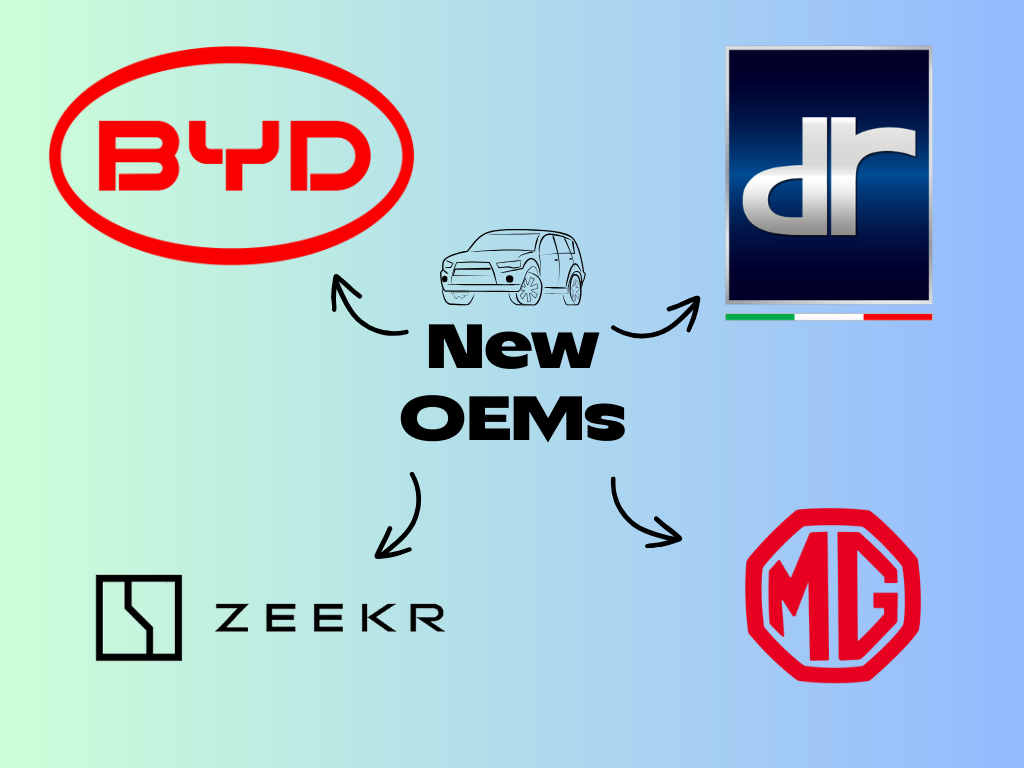
The arrival of brand new emerging car makers is turning the tide in the automotive market and many of the emerging OEMs have shifted their focus from less developed markets to prominent regions such as North America and Europe. According to Fleet Magazine, China stays the current undisputed leader in electric vehicle production with remarkable increases in sales in the European market.
A recent survey by Deloitte stated that most OEMs intend to enter major European markets like Germany and France within the next 3-5 years, and 75% of them are committed to exporting to North America. By venturing into highly competitive markets, emerging OEMs aim to gain brand recognition and enhance their capabilities in products, services, and technology.
Record-breaking numbers for Shenzhen-based carmaker BYD, with about 26 cars sold per hour. Warren Buffett invested $225 million in the company still in 2018, earning $4.5 billion two years later, in 2020.
BYD’s growth, however, is unprecedented: volumes in 2023 were nearly equal to electric and hybrid vehicle sales in the previous five years combined. Corporate sales in 2023 catapulted it into the global top 10 for the first time.
Zeekr is a brand under Geely Auto, one of China’s major automotive manufacturers, also formerly owner of the premium brands Volvo and Polestar. Zeekr is focused on electric vehicles (EVs) and is positioned as a premium electric brand.
According to some latest 2024 news, Zeekr is aiming to deliver 230,000 cars in 2024, doubling its numbers from 2023 and placing itself among the strongest emerging OEMs in the market.
DR is an Italian automaker founded in 2006. It established a unique business model, importing components from China’s Chery Automobile and assembling them under license in Italy. A strong global landmark to highlight the potential of partnerships between international players.
2022 was a breakthrough year for DR Automobiles, nearly 25,000 new vehicles registered and a market share in Italy of 1.86 percent, while sales rose to 448 million euros. An exponential growth in a highly competitive market.
Morris Garages, one of the most iconic British automotive brands, relaunched its brand image in 2019 in Europe after being acquired in 2007 by Chinese group Saic Motor.
MG cars are designed and engineered in the UK, but manufacturing is centered in China. MG is part of the list of brands with truly exponential market growth. As a matter of fact, MG’s 2023 sales have more than quadrupled in one year, and the British-Chinese brand’s market share has increased from 0.40 percent to 1.42 percent.
Emerging international carmakers are increasingly investing in innovation and technology, knowing it as a driving force to stand out today’s market needs.
The current trend around EVs is creating a great window of opportunity for new and incumbent players to penetrate the automotive game. Major players like BYD, Zeekr, DR, and MG exemplify this trend, each making significant strides in their unique ways, from record-breaking sales to innovative business models and exponential market growth.
As the automotive industry keeps growing and evolving, the emphasis on innovation and technology remains a common thread among these emerging players, positioning them to redefine the game in a market increasingly driven by the shift to EVs.
Digital Content and PR Specialist at 2hire
I love running and daydreaming losing count of the distance I’m covering, cooking (and especially eating) and Drake is my spirit guide.
Posted on January 31, 2024 by Benedetta Biggi
12 Jan 2024 | 4 min read
If you are reading this article, you cannot have missed the one where we talk about what 2hire does and the one where we explain what car rental software is about.
Today we breakdown how the combination of 2hire vehicle connectivity solution and the optimization of operations offered by car rental software are the trump cards for any car rental company that wants to turn its business around by positioning itself ahead of the competition.
2hire keyless technology can significantly contribute to enhancing the rental experience for car rentals by collaborating with car rental software companies in different ways and aspects. Let’s break down some of them!
2hire offers robust APIs that seamlessly integrate with the car rental software. This integration ensures a smooth experience for both the car rental software provider, minimizing technical glitches and enhancing overall reliability.
– End-to-End Integration → Every aspect of the rental process, from booking a vehicle to returning it, is seamlessly connected. Customers experience a unified interface, less confusion and enhanced usability.
– Compatibility Assurance → APIs act as bridges between different systems, ensuring that data and functionalities are exchanged flawlessly. When keyless technology APIs are designed to integrate with car rental software, it minimizes the likelihood of technical glitches or disruptions.
– Real-time Communication → APIs enable real-time communication between the keyless technology and car rental software. This ensures that critical information (e.g. reservation details, vehicle availability, user authentication, etc) is exchanged promptly.
– APIs fuel scalability → It allows for the addition of new features, functionalities, and improvements, without disrupting the existing integration.
2hire technology can collaborate with the car rental software company to develop customized solutions that meet specific business requirements.
– Versatility in Integration → Fleets can be made of different makes and models, 2hire has created a solution that seamlessly integrates with various vehicle models. This adaptability ensures that the keyless entry systems are versatile enough to cover the entire spectrum of a rental company’s fleet.
– Scalable Solution for Growth → With collaboration between 2hire keyless technology and rental software providers, when a car rental business expands, the technology should easily accommodate the growing demands without requiring a complete overhaul. Customized solutions ensure that the technology is flexible enough to evolve alongside the business, whether it involves expanding the fleet, entering new markets, or introducing innovative rental models.
– Feedback-driven Development → Feedback loops between 2hire keyless technology and car rental software ensure that the technology remains aligned with the evolving needs of the rental industry. Customization provides the agility required to implement these enhancements swiftly.
With improvements by 2hire keyless solution, rental software can be enhanced to provide rental companies with valuable insights into the GPS location, status, and condition of their entire vehicle fleet.
– Predictive Maintenance → Real-time monitoring allows rental companies to access live data on the condition of each vehicle in their fleet. By integrating keyless technology with advanced sensors and diagnostic systems, the rental software can provide predictive analytics.
– Optimized Fleet Utilization → Real-time insights into location and status of vehicles empower rental companies to optimize fleet utilization. Rental software can dynamically allocate vehicles based on demand patterns, ensuring an efficient use of resources.
– Reduced Downtime → Real-time monitoring enables rental companies to promptly identify and address issues as they arise. Whether it’s a mechanical problem, a low fuel level, or a maintenance requirement, the rental software can alert the relevant personnel or trigger automated responses.
Integrating 2hire keyless technology with customer support features in the rental software enables a unified platform for addressing issues. If a renter encounters difficulties with keyless entry, customer support teams can access relevant information and provide timely assistance, minimizing disruptions to the rental experience.
– Remote Assistance and Troubleshooting → Remote diagnosis of issues and troubleshooting problems not only reduces the need for on-site interventions but also contributes to a faster resolution of technical challenges. Remote assistance capabilities are crucial, especially when on-site support is not easily available.
– Feedback Loop → An integrated support system allows for collecting user feedback and sentiments. This feedback loop is valuable for both keyless technology providers and rental software companies. Analyzing customer support interactions and feedback can highlight areas for improvement in keyless technology, software interfaces, and overall service offerings.
– Customer satisfaction and loyalty → When renters experience timely and efficient support, it enhances their perception of the rental service, fostering loyalty and positive word-of-mouth recommendations.
2hire can collaborate with car rental software companies to gather and analyze data generated during the rental process. Insights derived from user behavior, usage patterns, and system performance can inform continuous improvements on both sides, ensuring an optimized experience over time.
– User Behaviour Insights → The collection of data on user interactions with keyless technology and rental software is an important aspect to highlight. Understanding how customers engage with the rental process, from booking to vehicle return, allows for optimization of user interfaces, mobile apps, and overall user experience to better align with customer expectations.
– Fleet Management Optimization → Data analytics can unveil usage patterns, peak rental hours, and popular vehicle choices. This information is invaluable for rental companies in optimizing fleet management and allocating resources efficiently.
– Predictive Maintenance Strategies → By analyzing historical data on vehicle performance and maintenance needs, rental companies can anticipate issues and schedule maintenance proactively.
– Personalization and Customization → Insights into user behavior allow for personalized and customized services. For instance, if data indicates a preference for certain vehicle types, features, or rental locations, the rental software can be adapted to tailor recommendations and offerings, providing a more personalized experience for customers.
2hire’s ultimate goal is putting connectivity at the forefront, dismantling the old concept of mobility through the complete digitisation of the rental process.
By fostering collaboration between 2hire keyless technology and car rental software companies, the rental experience can be elevated to new heights, offering customers a secure, convenient, and technologically advanced way to access and manage vehicles.
Digital Content and PR Specialist at 2hire
I love running and daydreaming losing count of the distance I’m covering, cooking (and especially eating) and Drake is my spirit guide.
Posted on January 11, 2024 by Benedetta Biggi
15 Dec 2023 | 3 min read
The car rental industry is undergoing a transformative journey, largely facilitated by cutting-edge car rental software solutions. These innovative technologies are not only omnipresent but also indispensable for the seamless functioning of rental businesses worldwide.
The evolution of car rental software is not just a technological advancement but a strategic choice for the future of the industry. As the world continues to embrace the digital age, these solutions are catalysts for growth and innovation. Today we decided to give a sneak peek about some of the most important players driving this innovation:
This Paris-based car rental software company is set to offer a flexible solution to help car rentals in their digitization. The company customizes the offer for each car rental based on the compatibility of specific car models, safeguarding and preservation of data, and continuous support and maintenance.
Eccocar is a Spanish software provider that offers a white label solution for car rentals, dealers, and urban mobility operators willing to launch their digital mobility projects and make a positive impact on the environment.
Playmoove is an Italian-based software company that provides the Playmoove platform: a multi-vehicle and multi-functionality management solution for different kinds of fleets, with a focus on sharing and micromobility but operating also in the sphere of car rental, corporate sharing, and hybrid models.
Italian-based SaaS in the automotive sector that offers a software development solution targeted at car rentals, workshops, and dealerships. MyRent works at the same time in the integration and partnership with other businesses and brokers.
World Wide Mobility is a leading Spanish tech company that specializes in developing and implementing mobility solutions such as MaaS (Mobility as a service) platforms, Vehicle Subscription Softwares, 100% digital Rental Softwares, Car-Sharing and Mobility Budget. Offering UX/UI design, hardware and software, for emerging and existing mobility providers like dealerships, manufacturers, rental companies and more.
As previously mentioned, rental businesses need innovative technologies for seamless functioning. Hence the importance of having a keyless solution integrated into car rental software, to have everything covered.
Keyless and car rental software intersect in different ways:
The global need for this kind of solutions is further highlighted by their capacity to help car rentals in the enhancement of the user experience.
In an era where convenience is paramount, these software solutions offer several benefits for renters. Seamless car access, intuitive booking process, and advanced data insights are just a few examples of how technology is enhancing the rental experience. Renters will be able to easily browse available vehicles, make instant reservations, and even have a customized user profile with their preferences and rental history. This customization enables a more personalized experience during subsequent rentals, as the software can offer tailored recommendations based on the user’s history and preferences.
The symbiotic relationship between technology and the car rental industry is poised to redefine mobility, offering users a seamless, secure, and sophisticated rental experience on a global scale. The road ahead is paved with opportunities, and car rental software is steering the industry towards a destination of unparalleled success.
Digital Content and PR Specialist at 2hire
I love running and daydreaming losing count of the distance I’m covering, cooking (and especially eating) and Drake is my spirit guide.
Posted on December 12, 2023 by Benedetta Biggi
29 Nov 2023 | 2 min read
The car rental software market experienced steady growth during 2022 and key players are now adopting new strategies, so the market is projected to increase more over time. In the forecast period between 2023 and 2030, the global market for online car rental software is expected to grow rapidly.
With a car rental software application, Car rental can manage their fleet users, vehicles, and customer bookings in one place.
The car rental software dashboard provided to car rental companies gives access to essential information such as customer data, GPS location, financial transactions, and so on.
It can be considered a modern solution for all car rental companies that aim at making their business more efficient, convenient, and cost-effective.
Car rental softwares can generate reports on various aspects of the business, such as revenue, occupancy rates, and vehicle utilization.
At any time, car rental companies have access to vehicle usage (km driven by customer, petrol consumption etc.), who rented the vehicle, customer history and ability to send customized offers. They can also know when to do maintenance, their front desk costs are reduced to zero, and by integrating the correct third parties, rentals can be provided with contactless access to the vehicle, and even driving behavior can be available.
It gains considerable time at the counter, it is sure to receive the car it had requested, receives dedicated and customized offers, potentially has a scoring of its driving system and preferential rates based on driving behavior.
Small, local operations may require a basic system, while larger, international companies may need more comprehensive solutions to manage their extensive fleets and customer bases.
Certainly, by automating and digitizing various aspects of the car rental process, car rental software significantly reduces manual tasks, improves accuracy, and enhances the overall efficiency of the operation. This allows rental companies to better serve customers, reduce operational costs, and increase profitability.
Digital Content and PR Specialist at 2hire
I love running and daydreaming losing count of the distance I’m covering, cooking (and especially eating) and Drake is my spirit guide.
Posted on November 13, 2023 by Benedetta Biggi
23 Aug 2023 | 2 min read
To stay ahead of the competition,companies are constantly seeking ways to optimize operations and streamline costs. When it comes to corporate travel, utilizing car rentals can provide numerous benefits that contribute to the success of a business.
In this article, we will explore how car rentals benefit businesses, enabling them to drive efficiency, flexibility, and savings.
In addition, nowadays a specific type of car rental is gaining ground: keyless rental. Keyless rentals are characterized by being, in short, digitized high-tech. Thus the customer experience when using these specific car rentals will be totally different.
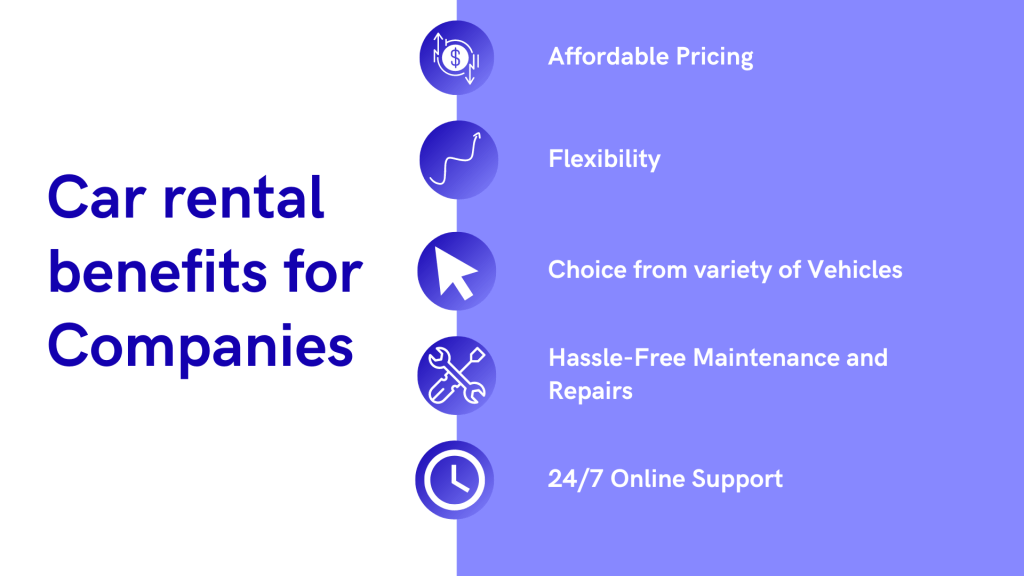
Car rentals offer a cost-effective solution for businesses. Instead of purchasing and maintaining a fleet of vehicles, renting allows companies to allocate their resources more efficiently. Car rentals eliminate the upfront costs of buying vehicles, as well as expenses associated with insurance, maintenance, and depreciation. By renting vehicles on an as-needed basis, businesses can save significantly on capital expenditures and operating costs.
Car rentals provide flexibility for businesses. Companies can easily adjust their vehicle requirements based on changing needs. Whether it’s a single executive attending a meeting or an entire team traveling for a project, car rental services offer a wide range of vehicles to accommodate different group sizes, preferences, and trip durations. This flexibility enables businesses to tailor their transportation solutions to specific requirements, ensuring maximum efficiency and convenience.
Car rental companies offer an extensive selection of vehicles, from compact cars to luxury sedans and spacious vans. Businesses can choose vehicles that align with their brand image and cater to the unique demands of each trip. Whether it’s impressing clients with a high-end car or accommodating a team with a comfortable and spacious vehicle, the diverse fleet of rentals ensures businesses have access to the right vehicles for their specific needs.
By renting vehicles, businesses can offload the burden of maintenance and repairs to the rental company. Rental vehicles undergo regular servicing and inspections to ensure optimal performance, minimizing the risk of breakdowns during critical business trips. This eliminates the need for in-house maintenance teams and allows employees to focus on their core tasks, boosting productivity and reducing downtime.
In addition to the aforementioned benefits, car rental companies also provide 24/7 online support, further enhancing the convenience for businesses. With round-the-clock customer service, businesses can access assistance and resolve any issues that may arise during their rental period. Whether it’s a question about the rental process, modifying a reservation, or addressing an unexpected situation, having access to responsive online support ensures that businesses can swiftly and efficiently resolve any concerns, no matter the time or day. This reliable support system adds an extra layer of confidence and peace of mind for businesses relying on car rentals for their transportation needs.
Car rentals offer a multitude of benefits that directly contribute to the success of businesses. From cost savings and flexibility to hassle-free maintenance renting vehicles for corporate travel drives efficiency and productivity. Embracing the advantages of car rentals allows businesses to optimize their resources and adapt to changing needs. By leveraging car rentals, businesses can unlock the full potential of their corporate travel and stay one step ahead in today’s competitive business landscape.
Digital Content and PR Specialist at 2hire
I love running and daydreaming losing count of the distance I’m covering, cooking (and especially eating) and Drake is my spirit guide.
Posted on July 20, 2023 by Benedetta Biggi
8 Aug 2023 | 2 min read
Renting a car for a business trip, vacation or simply for a time when you need it, proves to be a convenient and hassle-free option, especially if it is a contactless rental. However, to have a whole stress-free experience, it is good to have some more insights on how car rental insurance works.
Car rental insurance is always paid for by credit card. It can vary depending on the age of the driver and the model of the rented car. Each company perceives “insurance” differently: some include it in the package and some consider it an add-on.
This article showcases the basics of how car rental insurance works. In this way you’ll able to make informed decisions, having a worry-free experience on the road.
The three basic types of insurance required for rental cars are damage cover, theft cover, and third-party liability:
Starting from the damage cover, the Collision Damage Waiver (CDW) or Loss Damage Waiver (LDW) refers to a protection that limits what a car rental company can charge for repairs. It relieves you of financial responsibility if the rental car is damaged or stolen. It typically covers the cost of repairs or the car’s value, minus a deductible.
Each car rental company can have a different Collision Damage Waiver. This leads insurance formulas to include certain elements over others. For example, policies cover the roof, while others don’t.
Additionally, almost all types of insurance or coverage have an excess (called a deductible in the USA). The deductible is the maximum that the renter will pay towards bodywork repairs. It can range from $500 to $3,500 depending on the case.
Theft Protection covers the cost of replacing a rental car whenever it is stolen during the rental period. It may also include the cost of repairing the car if it is damaged when someone tries to steal it.
As the Collision Damage Waiver, the Theft Cover can have an excess or deductible. The deductible in this case is the amount the renter will need to pay if the car is stolen or if it gets damaged by third parties. Normally, many car rental companies include Theft Protection in their car rental rates, but it can also be sold as individual insurance.
In car rental, Third-Party Liability is a form of liability insurance. With this type of insurance, the insured is protected from damages caused to a third party, such as a person or property. It can cover expenses such as hospital care, lost wages, or repairs to the car’s bodywork.
Regarding liability insurance, its presence or absence in the basic form of insurance made available by the car rental company differs from country to country.
In Europe third party insurance, also called “civil liability” is held by the car rental owner and it covers possible damages to other cars and also injury to other drivers. This is a form of insurance that is mandatory in Europe to have for each car rental.
In the USA and part of South America, the third party responsibility lies with the driver of a rental car. In those countries car rental desks or websites can usually offer to the driver the so-called SLI: Supplementary Liability Insurance.
It provides coverage to injuries caused to driver/passengers of other cars and damages caused to other cars. In some states, car rentals must have SLI, but the states’ third-party damage minimums are relatively low, so you may want to consider purchasing an SLI policy.
Australia and New Zealand respect other regulations. The car rentals, must have insurance of third party injuries: a car without this kind of insurance cannot be rented.
In New Zealand third party personal injuries are settled through a government program called ACC which does not ascribe “fault” to either driver.
Car rental insurance offers protection and peace of mind when renting a vehicle. Understanding the different types of coverage available, reviewing policy terms and exclusions, and exploring alternative insurance options are crucial steps in ensuring a hassle-free rental experience. By being informed, you can make the best decisions to protect yourself and enjoy your journey with confidence.
Digital Content and PR Specialist at 2hire
I love running and daydreaming losing count of the distance I’m covering, cooking (and especially eating) and Drake is my spirit guide.
Posted on July 19, 2023 by Benedetta Biggi
03 Aug 2023 | 2 min read
In the car rental world, keyless solutions are transforming the rental experience for customers and businesses alike. This article highlights the differences between classic and keyless rental approaches, addressing the importance of adopting keyless solutions for improved customer satisfaction and enhanced operational efficiency.
Keyless rental systems remove the need for customers to visit front desks of rental offices. Reservation details, including vehicle location and access codes, are shared in advance via mobile app or digital platform. This streamlined process cuts off documentation, reduces waiting times, and provides a seamless pick-up experience. Customers can conveniently locate and unlock their rental vehicles using their smartphones, starting their journey promptly.
Traditional car rentals require customers to visit a rental office or counter, involving paperwork, identification verification, and contract signing. This often turns out to be a time-consuming, dated and stressful process for a typical modern-day smart customer. Locating rental vehicles in large parking lots can be time-consuming and confusing. Classic car rentals tend to be more labor-intensive, resulting in a less efficient and slower pick-up experience.
Keyless rental systems offer flexibility and convenience during drop-off. Customers can return the vehicle at their own pace within the agreed-upon rental period. By using a mobile app, customers easily locate designated parking spaces or drop-off zones, ensuring a smooth return process. The elimination of physical key handovers minimizes the chances of misplaced or lost keys, saving time for both customers and car rental companies.
In classic rentals, customers typically return vehicles to rental offices or specified locations. This can be inconvenient, especially if the drop-off location differs from the pick-up point. Waiting for available staff to accept the returned vehicle and conduct inspections can further prolong the process. Classic rentals involve more manual labor and present challenges for time management during drop-off.
For businesses and corporations managing large fleets, keyless solutions boost productivity by eliminating key handovers and documentation. Keyless systems facilitate efficient tracking and management of rentals, reducing errors, and ensuring a seamless process for corporate clients.
Keyless Rental solutions employ advanced encryption technologies, making it difficult for unauthorized individuals to access vehicles. Additional features like real-time monitoring enhance security measures, providing peace of mind for businesses and corporate clients.
Implementing keyless rental systems leads to cost savings for businesses, lower staffing requirements, and improved operational efficiency to optimize resources. Keyless systems provide valuable data insights, enabling businesses to track vehicle usage, identify inefficiencies, and make data-driven decisions for fleet optimization.
Keyless rental solutions are revolutionizing the car rental industry by improving customer experiences and streamlining operations. With efficient pick-up and drop-off processes, keyless rentals provide convenience, time savings, and enhanced security. Adopting keyless solutions is essential for businesses and corporations seeking to elevate customer satisfaction, boost productivity, and achieve cost savings in the competitive car rental market.
Digital Content and PR Specialist at 2hire
I love running and daydreaming losing count of the distance I’m covering, cooking (and especially eating) and Drake is my spirit guide.
Posted on July 17, 2023 by Benedetta Biggi
23 Oct 2023 | 3 min read
According to a BCG report, subscriptions provide an opportunity to develop an ongoing relationship with customers, something previously beyond OEMs reach.
The traditional perception of OEMs has gradually switched from vehicle manufacturers to true mobility players. They are offering a range of new mobility services options and car subscriptions is one of them.
Mobility options have evolved towards a more all-encompassing direction: rental, sharing, ride hailing, peer to peer car sharing, and so on are just some examples.
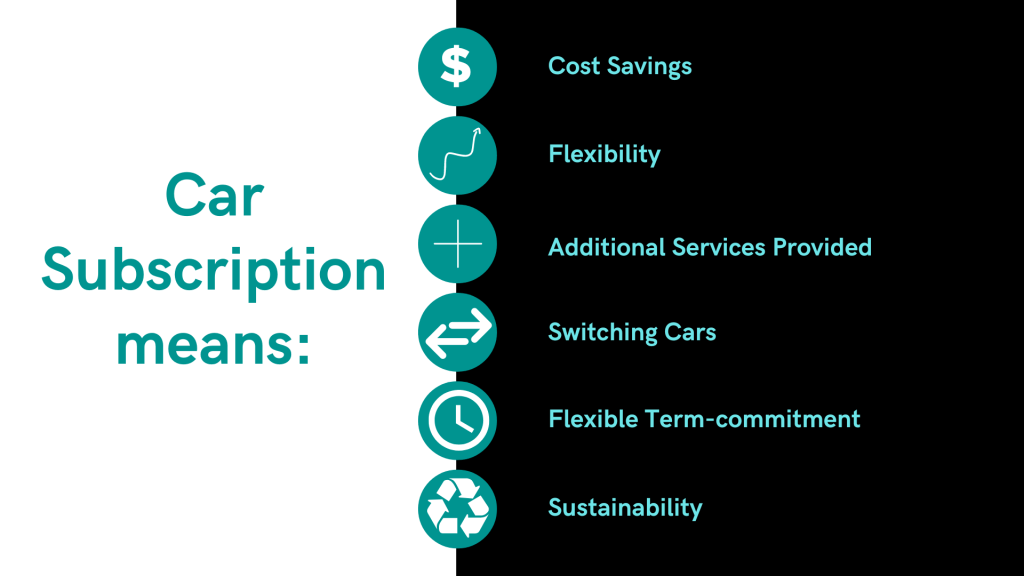
The products and services associated with alternative mobility options are attractive to the modern consumers. Today’s consumers make mobility decisions driven by factors such as lower commitments, greater flexibility, convenience, and wider choice. Car subscriptions currently offer these features and OEMs are embracing the change.
OEMs started to reconsider their business model when assimilating the concrete potential of a subscription-based offer.
For OEMs, vehicle subscriptions offer an annuity revenue stream and the opportunity for frequent interactions with consumers, which can strengthen the relationship between the two parties. The adoption of subscription models may also facilitate direct-to-consumer sales, allowing OEMs to establish online, contactless sales channels.
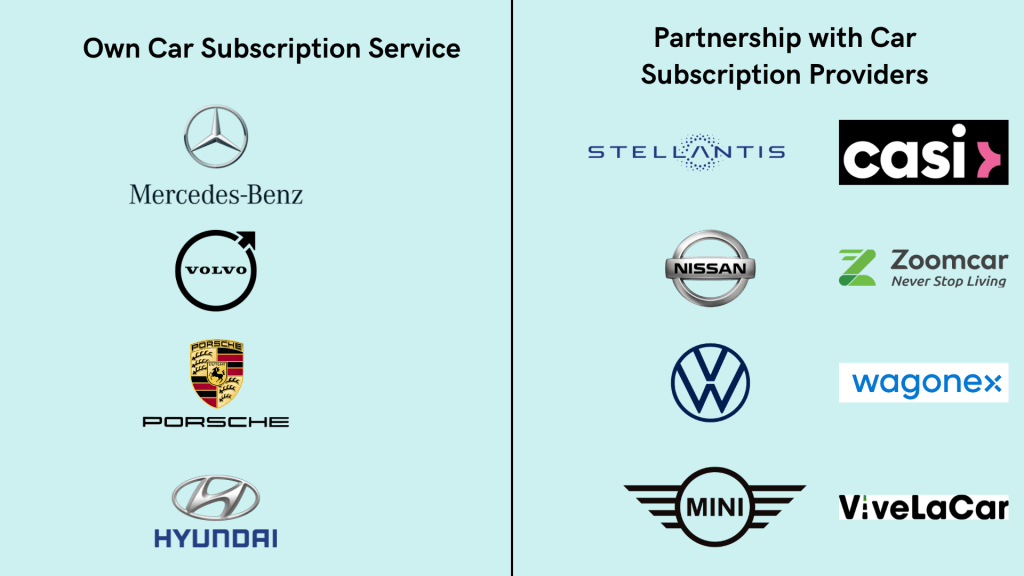
As mentioned in the previous episode, there are currently two ways in which OEMs are approaching car subscription offers: a personal entrance in the car subscription market or by partnering with third party car subscription providers.
OEMs launching their own car subscription service possess a double advantage since they are suppliers of those same vehicles:
A subscription model can be seen as a promotional marketing tool for possible future drivers who want to try new models with minimum commitment and maximum flexibility experience.
Mercedes-Benz Subscription is one of the heading subscription services offered in Europe by an OEM. Within 2025, the German manufacturer aims to generate €2 billion in revenue from subscription-based features. It first announced its plans to offer subscription-based features back in 2018 and right now is offering a full- service flexible contract with all the costs included (insurance, maintenance, road tax, registration fees and tyres) except from battery/fuel refueling.
The Mercedes-Benz subscription model addresses the specific requirements of customers who prefer to use a vehicle for a specific duration and cover all associated expenses through a fixed monthly payment. The rise of e-mobility is further fueling this trend, with over one-third of EQ customers in Germany already opting for the subscription model as their preferred financing method.
OEMs may partner with third-party car subscription service providers to offer subscription services. In such cases, the OEM provides the vehicles, and the subscription provider handles the operational aspects, including customer acquisition, maintenance, and logistics. These collaborations bring together the manufacturing expertise of OEMs and the operational capabilities of subscription service providers to offer all-round car subscription programs.
Stellantis group recently partnered with the startup Casi to launch Drivenjoy, a new car subscription service in the Netherlands aimed at reaching new customer segments and improving new customer deliveries while implementing a new revenue stream.
This is just an example to showcase how shared expertise is one great asset emerging from a partnership of this kind. OEMs bring their expertise in vehicle manufacturing, engineering, and quality control to the partnership, supplying the vehicles for the subscription programs, ensuring a reliable and consistent fleet for subscribers.
While car subscription providers handle the operational aspects of the program, including customer acquisition, marketing, logistics, maintenance, and customer support. They leverage their experience and infrastructure to manage the day-to-day operations efficiently.
Car subscriptions represent a transformative shift in the automotive industry, and OEMs are actively embracing this revolution. By offering flexible, all-inclusive subscription models, OEMs are meeting the evolving demands of modern consumers and exploiting the opportunities for revenue growth and enhanced customer relationships. As the subscription trend continues to expand, OEMs will play a vital role in shaping the future of mobility and ownership experiences.
Digital Content and PR Specialist at 2hire
I love running and daydreaming losing count of the distance I’m covering, cooking (and especially eating) and Drake is my spirit guide.
Posted on July 10, 2023 by Benedetta Biggi
Roma, 17 Ottobre 2023
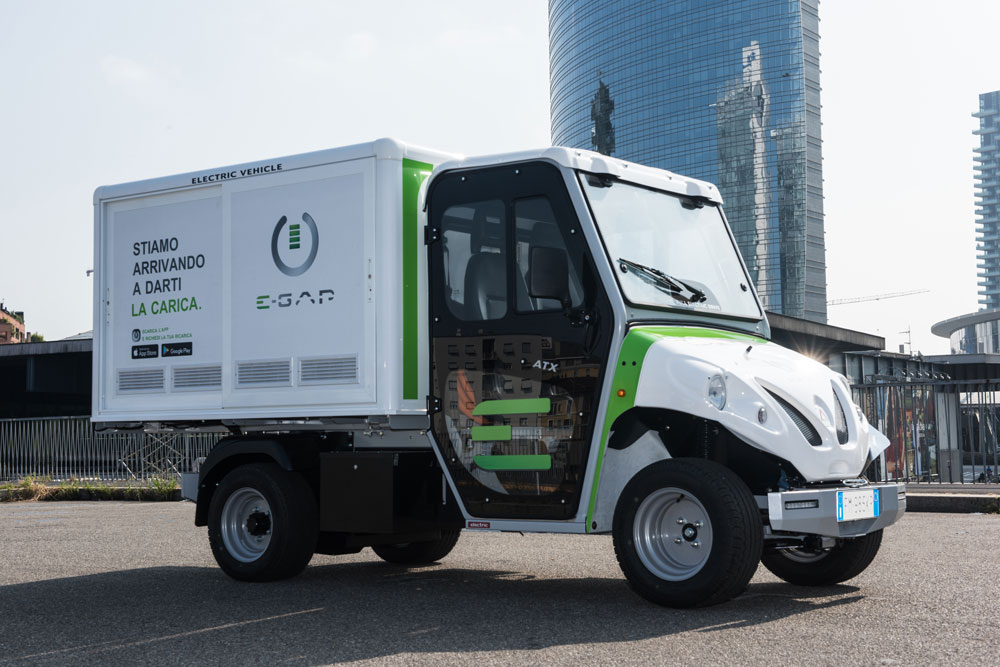
Grazie alla tecnologia di 2hire, E-GAP – società per la ricarica smart dei veicoli elettrici – è da oggi in grado di fornire ai propri clienti il servizio di ricarica on-demand in modalità connessa, per un’esperienza completamente digitale e senza stress.
L’offerta, inizialmente disponibile per i proprietari di Fiat 500 elettrica grazie alla collaborazione con Stellantis, permetterà ai clienti di E-GAP di ricevere la ricarica in maniera completamente digitale. Il cliente potrà infatti autorizzare E-GAP a sbloccare l’auto per la ricarica in autonomia e sicurezza, evitando di doversi recare fisicamente presso la propria vettura.
“Questa innovativa connessione tecnologica tra il veicolo e il nostro sistema di ricarica rappresenta un significativo passo avanti nel nostro impegno a fornire un servizio all’avanguardia nel mercato della mobilità e sempre più centrato sul cliente che guida in elettrico. Ciò permetterà ai nostri clienti di risparmiare un tempo maggiore grazie all’accesso diretto da parte di E-GAP allo sportello dell’auto” – Francesco De Meo, Head of Marketing di E-GAP
Nei prossimi mesi l’innovativa modalità di ricarica sarà disponibile anche per gli altri modelli elettrici del gruppo Stellantis, e successivamente per gli altri brand.
La tecnologia di 2hire permette a servizi innovativi come quello offerto da E-GAP di accedere digitalmente ai veicoli, dietro il consenso dei propri clienti e in maniera sicura, per una user experience premium, innovativa e tecnologica.
Posted on July 10, 2023 by Benedetta Biggi
19 July 2023 | 3 min read
In the United States, where the automobile has dominated transportation since the 1950s, there are literally more cars than households — 1.88 per household to be exact. Yet, in recent years, the focus has been moving to less committed options, and here is where car subscription pops up: commonly defined as the subscription-based Netflix for cars.
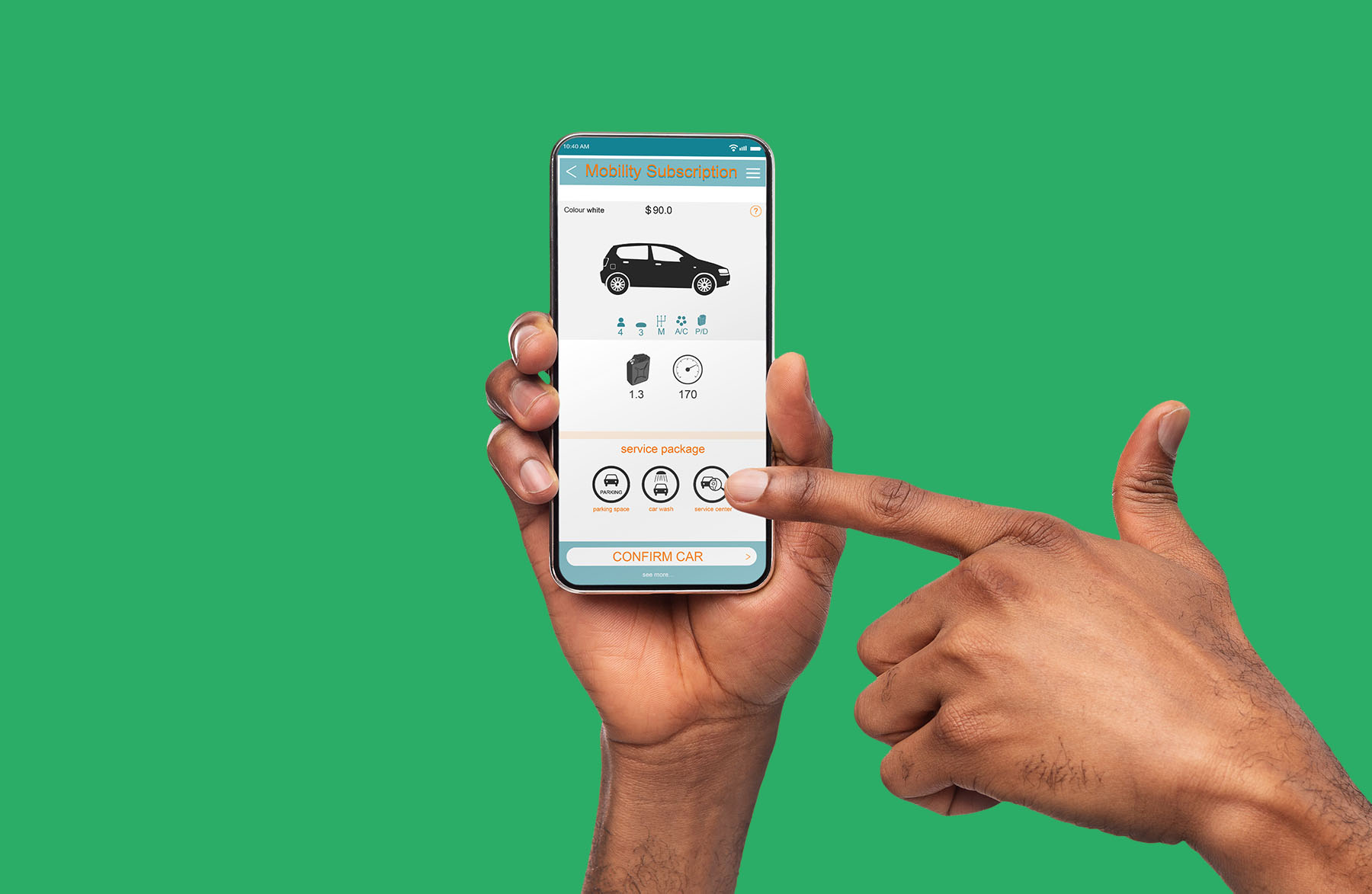
Subscription services have gained popularity as an alternative to traditional car ownership or leasing, offering consumers a flexible and convenient way to access vehicles without the long-term commitments and financial burdens associated with purchasing or leasing.
The global vehicle subscription market size was valued at $2.11 billion in 2021 and is projected to grow from $3.38 billion in 2022 to $172.47 billion by 2029 with more than 16.3 million new and used cars to be part of the vehicle subscription market by 2025.
Europe keeps dominating the vehicle subscription market share with a value of 0.91 billion just in 2021, with the German car subscription market size valued at USD 219 million in 2021. It is projected to reach USD 2,779 million by 2030, growing at a CAGR of 33.5% during the forecast period (2022-2030).
Moreover, every year between 3 and 3.5 million new cars are sold just in Germany and even during the Corona pandemic in 2020, more than 2.9 million new cars were sold. The presence of some of the major car manufacturers in Europe such as Volkswagen, Mercedes, BMW and others is driving the car subscription market on a consistent growth.
Two other major changes that impacted in the rise of popularity of vehicle subscription are:
Rising cost of vehicle ownership in fuel prices, and shortage of microchips, insurance and so on have deeply contributed to high operating expenses. Encouraging users even more to prefer a subscription-based service, less challenging and more flexible.
As of now, the business opportunity around new concepts of car usage and ownership is evident.
Consumers are no longer actively eager to buy a car, they prefer to opt for a less committal solution that allows them space to change quickly and without particular economic and contractual constraints.
In this scope, OEMs dipped their toes into this new market in two ways:
1. Direct entry into the car subscription market
2. Partnering with car subscription services to offer their own customized subscription program.
Car manufacturers are recognizing the pivotal role of subscription models in how vehicles are used and perceived.
The success of Care by Volvo subscription program is a great example, stating that their car subscription service accounted for 15% of total UK retail sales and drove the uptake in new plug-in hybrid electric models.
Overall, OEMs still have large space of expansion in the subscription market and can reach it without overhauling their current internal operations since:
The car subscription market data speaks loudly, it is experiencing significant growth and transformation as consumers seek flexible and convenient mobility solutions. Both OEMs and subscription companies play crucial roles in shaping this evolving landscape. OEMs leverage their manufacturing expertise, brand recognition, and vehicle offerings to supply the cars for subscription programs, while vehicle subscription companies bring operational capabilities, customer acquisition strategies, and service management to the table.
The subscription market keeps redefining personal mobility and is offering individuals a convenient, customizable, and hassle-free alternative to traditional car ownership or leasing.
What’s next? We’ll dive deeper into the OEMs current scenario around car subscription. Stay tuned!
Digital Content and PR Specialist at 2hire
I love running and daydreaming losing count of the distance I’m covering, cooking (and especially eating) and Drake is my spirit guide.
Posted on July 5, 2023 by Benedetta Biggi
13 Jul 2023 | 2 min read
In recent years, the sharing economy has witnessed remarkable growth across various industries, and the automotive sector is no exception. The sharing economy is an economic system in which assets or services are shared between private individuals, either free or for a fee, typically by means of the internet. Traditional car ownership is being challenged by innovative alternatives typical of the sharing economy providing flexibility and convenience. One such trend that has gained significant traction is the vehicle subscription solution. This article explores the rise of vehicle subscription services and their impact on the automotive sharing economy.
The concept of shared automobility consists of utilizing vehicles as a service rather than owning them outright.
Shared automobility appears to be here to stay! According to Statista, in the shared Vehicles market, the number of users is expected to amount to 5.09bn users by 2027. While the user penetration is 88.3% in 2023 and is expected to hit 92.8% by 2027.
Shared mobility encompasses various forms of transportation, including car subscription, car sharing, ride-hailing, bike sharing, peer to peer car sharing and more. Within this realm, vehicle subscription services have emerged as an increasingly popular option for individuals seeking a flexible and hassle-free approach to accessing vehicles.
Vehicle subscriptions within the realm of shared mobility operate on a membership or subscription basis. In this way they allow individuals to have on-demand access to a fleet of vehicles without the responsibilities of the traditional car ownership.
If you want to know how a car subscription model works, in our previous article we have highlighted the main features of a vehicle subscription model.
Vehicle subscription solutions promote the concept of sharing resources, leading to a reduced environmental impact. In this way with a shared pool of vehicles, the number of cars on the road can be significantly reduced. This results in lower carbon emissions, reduced traffic congestion, and a more sustainable urban environment.
Vehicle subscription services can evolve into peer-to-peer car sharing platforms. Vehicle owners can leverage the subscription model to rent out their cars during idle periods, generating additional income. This decentralized approach allows individuals to contribute to the sharing economy while optimizing the utilization of existing resources. Vehicle subscription services can evolve into peer-to-peer car sharing platforms. Vehicle owners can leverage the subscription model to rent out their cars during idle periods, generating additional income. This decentralized approach allows individuals to contribute to the sharing economy while optimizing the utilization of existing resources.
Vehicle subscription services complement public transportation systems and help bridge the gap between private car ownership and shared mobility solutions. By providing a convenient alternative to car ownership, these services encourage individuals to rely less on personal cars, promoting a more efficient and multimodal transportation ecosystemons.
Vehicle subscriptions play an important role in the shared mobility revolution. By offering a flexible and convenient alternative to traditional car ownership, these services provide individuals with access to a diverse range of vehicles without the associated burdens. As the demand for sustainable and cost-effective transportation options continues to grow, car subscriptions are expected to play an increasingly significant role in shaping the future of shared mobility.
Digital Content and PR Specialist at 2hire
I love running and daydreaming losing count of the distance I’m covering, cooking (and especially eating) and Drake is my spirit guide.
Posted on June 27, 2023 by Benedetta Biggi
10 Jul 2023 | 2 min read
In the ever-evolving landscape of mobility, car subscription services are emerging as a popular choice among Millennials and Generation Z. This innovative model of car ownership offers a lot of benefits that align perfectly with the lifestyle and values of these younger generations.
One of the core reasons driving Millennials and Gen Z toward car subscription solutions is the switch from “definitive ownership” to “temporary ownership”. The change is due to several sociocultural factors and is becoming more and more widespread, especially among Millennials or people belonging to Gen Z: from an increasing environmental awareness, to urbanization, to the reduced importance of car ownership as a status symbol.
One of the most significant advantages of vehicle subscription services is the flexibility they offer. Unlike traditional car ownership, which requires a long-term commitment, car subscriptions allow users to switch vehicles as their needs change. This flexibility is particularly appealing to Millennials and Gen Z, who value experiences over possessions and prefer not to be tied down by long-term commitments.
Moreover, car subscription services offer unparalleled convenience. They typically include insurance, maintenance, and roadside assistance in the monthly fee, eliminating the need for separate arrangements.
Upfront costs associated with buying a car, such as down payments and registration fees, are eliminated. Instead, users pay a predictable monthly fee, making budgeting easier. This cost-effectiveness is particularly attractive to Millennials and Gen Z, who are often grappling with student loans and other financial pressures.
Car subscription services also align with the environmental values of Millennials and Gen Z. By allowing users to switch vehicles easily, these services enable them to choose more eco-friendly cars as they become available. This flexibility can contribute to reducing carbon emissions, a goal that is increasingly important to younger generations.
Car subscription services often come with integrated technology features, such as app-based booking and digital keys. These features appeal to Millennials and Gen Z, who are digital natives and expect seamless integration of technology in all aspects of their lives.
Car subscription services offer a compelling alternative to traditional car ownership for Millennials and Gen Z. As we move into the future, it’s clear that car subscription services are not just a passing trend, but a significant shift in the way we think about personal mobility.
Digital Content and PR Specialist at 2hire
I love running and daydreaming losing count of the distance I’m covering, cooking (and especially eating) and Drake is my spirit guide.
Posted on June 26, 2023 by Benedetta Biggi
22 Jun 2023 | 2 min read
In recent years, peer to peer car sharing has gained significant traction as a convenient and cost-effective alternative to traditional car rental services.
In the previous article, we talked about the USA cities that have embraced this new mobility solution. Today, we’ll explore the cities in the UK where the P2P car sharing phenomenon is most widespread.
Three of the major players in this industry – Turo, Hiyacar and Getaround – have established a strong presence in various cities across Britain.
Turo, one of the leading peer to peer car sharing companies, has made its mark in four prominent British cities. In London, Turo offers an extensive fleet of vehicles, catering to diverse needs and preferences. Manchester, renowned for its vibrant culture, also benefits from Turo’s convenient peer to peer car sharing services. In Edinburgh, visitors and residents can explore the city’s historical charm and surrounding areas with ease. Bristol, with its rich artistic and cultural scene, is yet another city where Turo has gained popularity. By unlocking access to a wide range of cars, Turo empowers individuals to navigate these cities conveniently and enjoyably.
Hiyacar, a prominent peer to peer car sharing platform, operates not only in London but also in several smaller boroughs, including Hackney, Dalston, Clapham, Islington, Streatham, Balham, and King Cross. London, being a bustling metropolis, benefits greatly from Hiyacar’s services. Whether you need a car for a few hours or a few days, Hiyacar provides a seamless booking process and an extensive selection of vehicles. The expansion of Hiyacar into smaller boroughs reflects the growing demand for localized peer to peer car sharing solutions, offering residents more convenient options for short-term transportation needs
Getaround is another major player in the peer to peer car sharing market, operating in multiple cities across the UK. In addition to London, Getaround operates in Birmingham, Glasgow, Edinburgh, Brighton, Manchester, Bristol and Liverpool. By expanding its reach beyond the capital, Getaround connects car owners and renters in several cities, promoting sustainable and cost-effective transportation solutions. With a focus on user-friendly platforms, Getaround enables travelers and locals alike to access convenient and reliable cars across different regions.
Turo, Hiyacar and Getaround have transformed the way people access transportation in prominent cities across the UK. With their cost-effectiveness, convenience and wide vehicle selection, they offer a valuable alternative solution for traveling around. By empowering individuals to easily find and book vehicles in their desired cities, these P2P car sharing companies contribute to more sustainable and efficient transportation solutions, ultimately enhancing the overall mobility experience.
Digital Content and PR Specialist at 2hire
I love running and daydreaming losing count of the distance I’m covering, cooking (and especially eating) and Drake is my spirit guide.
Posted on June 20, 2023 by Benedetta Biggi
19 Jun 2023 | 2 min read
Peer to peer car sharing has revolutionized the way people access transportation, providing a convenient and cost-effective alternative to traditional car rental services. In the United States, several cities have embraced this innovative sharing economy model. In this way USA citiews allow individuals to rent out their personal vehicles to travelers or business travelers who need a quick and comfortable mobility solution.The following article showcases the most popular cities in the United States for P2P car sharing. The research led to 5 prevalent cities: San Francisco, Los Angeles, Seattle, Portland and Chicago.
The reasons for higher concentration in certain cities are different: from high population density to the presence of high tourism to the problem of parking.
San Francisco, renowned for its tech-savvy population and progressive mindset, has emerged as a prime hub for peer to peer car sharing. There are several factors that led to a thriving market for P2P car sharing companies like Getaround and Turo. With numerous vehicles available for rent throughout the city, San Francisco residents can easily access cost-effective transportation options when needed.
As the second-largest city in the USA, Los Angeles faces notorious traffic congestion and parking challenges. P2P car sharing has gained significant popularity in LA. Residents monetize their underutilized vehicles and provide an affordable alternative for those in need of transportation. Once again Turo has established a strong presence in the city, offering a wide variety of vehicles for rent provided by numerous Hosts.
Seattle’s forward-thinking culture and commitment to sustainability have made it a hotbed for peer to peer car sharing. With a well-developed public transportation system and a tech-savvy population, platforms like Zipcar and Turo have flourished in the city. Seattle residents appreciate the flexibility and convenience of renting vehicles from their neighbors. Renting cars in this way reduces congestion and carbon emissions in the process.
Portland, known for its eco-conscious community and bike-friendly infrastructure, has embraced the P2P car sharing movement. Portlanders appreciate particularly the environmental benefits and cost savings associated with peer to peer car sharing.
Again, P2P car sharing companies like Getaround and Zipcar have gained a significant popularity. Thanks to these platforms residents access vehicles on-demand without the burden of car ownership.
In the heart of the Midwest, we find Chicago. The city has become a significant player in the peer to peer car sharing landscape. The city’s bustling urban environment, coupled with its expansive public transportation network, has created a strong demand for P2P car sharing services.
Peer to peer car sharing has gained traction in various cities worldwide, especially in the USA. Not by chance P2P car sharing consists of an innovative solution to urban transportation challenges. Peer to peer car sharing Hosts in the USA have embraced this sharing economy model, as they understood how functional the service features could be for their cities. From San Francisco to Chicago, residents and visitors in these cities can enjoy P2P car sharing platforms. The main attractive features of P2P car sharing platforms are the convenience, affordability, and sustainability. As this trend continues to grow, we can expect more cities across the country to adopt and benefit from this innovative transportation solution.
Digital Content and PR Specialist at 2hire
I love running and daydreaming losing count of the distance I’m covering, cooking (and especially eating) and Drake is my spirit guide.
Posted on June 13, 2023 by Benedetta Biggi
13 Jun 2023 | 2 min read
The connected car market in Italy is experiencing remarkable growth, driven by advancements in technology and the increasing demand for connected services. This article examines the market data and trends surrounding connected cars and Advanced Driver Assistance Systems (ADAS) in Italy, shedding light on the substantial growth witnessed in recent years.
The market for connected cars and ADAS in Italy has witnessed significant expansion over the past few years. Just think that in 2022 the Connected Car & Mobility market in Italy reached EUR 2.5 billion, +16% compared to 2021.
Here is a breakdown of the market size in billions of euros (mld):
Italy has seen a remarkable adoption rate of connected cars. In 2021 out of the total circulating fleet of 39.8 million vehicles, approximately 47% (18.4 million) are connected, showcasing a 2% increase compared to 2020. The connectivity technologies employed by these vehicles are of different types, as follow:
Italian consumers have shown a keen interest in additional connected car services. The total number of connected car services in Italy has reached 400 million, representing an 18% increase from 2020. As a result of researches:
According to a recent CAWI survey conducted by the Osservatorio Connected Cars and Mobility in collaboration with Doxa in January 2023, 52% of consumers own a smart car with associated connectivity services. The most commonly used services are:
In addition, among those who plan to buy a connected car in the future, as many as 75% are willing to pay an additional price for smart features. That’s not all: One in three consumers would only do so after a trial period, while one in four would pay for everything right away.
This is due to the fact that people are becoming increasingly aware of the smart features inherent in vehicles for two main reasons:
The management of data cars and infrastructure plays a significant role in the market. The revenue generated from the sale of services related to connected cars and ADAS is expected to reach 480 million euros in 2023.
Digital Content and PR Specialist at 2hire
I love running and daydreaming losing count of the distance I’m covering, cooking (and especially eating) and Drake is my spirit guide.
Posted on June 13, 2023 by Benedetta Biggi
06 Jun 2023 | 2 min read
In today’s fast-paced world, car ownership is evolving, with various forms and options of car rental available in the automotive market. Car sharing (including peer-to-peer), car rental, car leasing, and car subscription are all valuable options for drivers. In this article, we will focus on car subscription and explore its concept and benefits.
A car subscription is a business model where a customer accesses to a car for a recurring fee and for a fixed period. Unlike traditional rental and leasing services, it offers greater flexibility. Not by chance subscribers can switch to a different car whenever their needs change.
Subscribers can choose from a wide range of cars, from city cars to luxury cars, depending on their requirements. The service offers an all-inclusive package that covers maintenance, insurance and roadside assistance. The all-in formula makes the subscription an attractive option for drivers.
This innovative type of car ownership offers a modern and flexible solution for drivers who need the benefits of car ownership but without the long-term commitment. Thanks to all the advantages, people are reshaping the way they think about personal transportation, especially for millennials and members of Gen Z.
Volvo (with Care by Volvo) , Facedrive, ViveLaCar, SIXT (with SIXT + Car Subscription) and many others are beginning to appreciate the value of this new form of ownership. From OEM’s to car rentals, from new mobility startups to tech players.
Digital Content and PR Specialist at 2hire
I love running and daydreaming losing count of the distance I’m covering, cooking (and especially eating) and Drake is my spirit guide.
Posted on June 5, 2023 by Benedetta Biggi
5 Jun 2023 | 2 min read
As a father of two kids, aged 11 and 8, our daily life is a constant juggle between work, school, swim practice for my son Matteo, and piano lessons for my daughter Francesca, whom we affectionately call “the little one.”
When my wife and I switched to a connected electric vehicle, we made the choice with two main ideas in mind. First, out of a sense of responsibility towards the future of the planet. Secondly my wife and I never had to play the “where did we park?” guessing game again. The second one may seem like a small advantage, but it’s saved us from a lot of stress and frustration. No more missed appointments or rushed meetings because one of us couldn’t find the car. With the location always at our fingertips, we can easily coordinate and plan our days without any hassle.
Unfortunately, a small but significant complication we had was the need to charge the vehicle. Charging the vehicle meant finding the time to drive to a charging station, wait for it to charge, and then get back on the road again. This often meant being late to swim or piano lessons due to city traffic. Or having to charge the vehicle during our children’s lessons and arriving late to pick them up.
Alternatively, we would have to go in the evening, when we wanted to spend time together as a family.
Everything changed drastically a few days ago when I received a notification directly on my car maker’s app, which led me to a range of connected services around my connected car, including this on demand charging service.
With just a few clicks, I was able to get my vehicle charged during Matteo’s swim race, without having to leave the pool area. I was finally able to watch his race without any problems. The registration process was easy and intuitive. All I had to do was grant permission to locate my vehicle and book the service for a specific time and location. When I left the pool, my vehicle had been charged without me ever being physically present.
For those with busy lives, like my wife and me, who are both working parents with children old enough to have commitments but too young to move around independently in a big city, this type of service is a game-changer. I can’t wait to see what new services will be offered to me in the future through our connected car.
Data Scientist at 2hire
Less is more. I look for science and numbers in all my interests and emotions with the people I surround myself with.
Posted on May 30, 2023 by Benedetta Biggi
15 May 2023 | 2 min read
E-mobility represents a sustainable opportunity, but one of the biggest obstacles to the spread of electric cars is the deficiency of e-charging infrastructures. This shortage combined with the charging necessity of electric vehicles, causes people to approach e-mobility with caution.
Not by chance, one of the greatest fears of drivers is that the vehicle could remain without electric charging. The solution to this problem lies in on-demand e-charging: a smart and innovative way to charge an electric vehicle. No need to be alarmed because you don’t have to look for a solution to recharge your electric vehicle. On the contrary, it is the charging that comes to you!
On-demand e-charging is fast charger-level charging performed generally via zero-emission e-vans. The recharging service allows users to recharge users vehicles wherever they’re located.
E-Gap is a great example of on-demand fast e-charging service. Through the E-GAP smartphone app, you can book a “fast charge” at home with a zero-emission e-van.
In order to receive a premium on-demand charging service provided by E-gap, you have to own a connected vehicle and follow just a few steps. Simply download a dedicated application on your cell phone and book the recharge, indicating the location of the vehicle and the time you prefer. Once the e-van has reached the vehicle, an operator dispenses the recharge and you are ready to go again.
In this way, two major hurdles are solved:
Greater commitment to environmental sustainability and a lack of infrastructure for charging electric vehicles are just some of the needs that e-charging meets.
Starting with sustainability: owning an electric vehicle (instead of the classic ones) today has a significant environmental impact. Only think about that in over a year, just one electric vehicle on the roads can save an average 1.5 million grams of CO2.
When it comes to electric columns, an increase is needed, but presently electric on-demand e-charging is a valuable alternative. However, the use of this alternative charging mode implies that the electric car must be connected to take advantage of this service.
Once again the importance of having a connected vehicle comes out so that the user can take advantage of all the services available for this type of vehicle. In this specific case: being able to recharge a vehicle without the need to look for an electric charging station.
Digital Content and PR Specialist at 2hire
I love running and daydreaming losing count of the distance I’m covering, cooking (and especially eating) and Drake is my spirit guide.
Posted on May 15, 2023 by Benedetta Biggi
23 May 2023 | 3 min read
Owning a connected car opens up a world of possibilities that go beyond mere transportation. It’s a digital experience that can take car ownership to the next level. However, as a connected car owner, there are many aspects to be taken into account, especially when it comes to the needs and services around your vehicle.
Through a connected car, a user can satisfy a range of needs that would be inconceivable with a non-connected vehicle, saving time, energy, and strain!
If you own a connected car and want to simplify your daily life, accessing premium connected services for your vehicle can be the way to go. From in-car delivery service directly to your car trunk, to on-demand e-charging and on-demand car care to charge or wash your car while you are at work or at dinner, there are several possibilities to streamline your time!
When someone buys a connected car, it automatically receives access to the car maker’s app. Up to now, the services provided directly by car makers are basic services such as GPS location of the vehicle, maintenance reminders, and a few more.
OEMs are still lagging behind when it comes to in-house connected services, which is why third-party operators in most cases can fill this lack.
In fact, OEMs can incorporate third-party services into the carousel of offers for connected car owners through the car app that can be used as a showcase to display all the connected services available to choose from.

Then, the service provided by the third-party operator can be accessed via the service provider’s app or via the car maker’s app with which each operator has a partnership in place.
1️⃣ With your connected car account you can subscribe to different services and take advantage of some of the coolest news in the market, depending on the brand and model of your car.
2️⃣ Among the available services, all you have to do is choose the service that suits your needs, download the operator app, and follow the registration steps to request and book the service.
2️⃣.1️⃣ During the registration for the service you will be asked to connect your car and authorize the service provider to access some data such as GPS position/battery level and interactions such as opening/closing car trunk/charging door/doors. Everything happens under your supervision. You, as the owner of the connected car, decide what data and with which partners to share this data. Safety always comes first as the access to your car by the authorized operator is secured by cryptography and it is limited to the delivery of the service within the predefined time window.
3️⃣ Once you have completed registration and provided access to the chosen data and interactions via the app, you can book the service!
NB 💡 Remember that, at any time, you’ll be able to revoke access to the service provider through your connected car account.
A company like 2hire works with both carmakers and third-party services providers in order to enable these digital mobility services around connected cars.
Thanks to 2hire, connected car owners can enjoy a seamless and over-the-edge experience for their car with all the available on-demand services that are starting to spread right now. By collaborating with carmakers and third-party service providers, 2hire enables a comprehensive range of services that cater to the needs of modern-day drivers and fill the technological gap between OEMs and connected services providers. From the digital booking of parcel delivery into the car to the request for fast EV charging while at work, the possibilities are endless.
Thanks to the connected services offered by carmakers and service operators, powered by technology companies like 2hire, owning a connected car is becoming smarter, safer, and more convenient than ever before.
Owning a connected car is not only about convenience, but it’s also a significant time saver compared to traditional cars. With the ability to charge your EV on-demand and have a car wash delivered straight to your doorstep, you can avoid the hassle of finding time in your busy schedule to fit in these essential tasks. In addition, connected car owners can benefit from innovative services such as in-car delivery, which can save them precious time when they are unable to receive a parcel at a specific location. Instead, the parcel can be delivered straight to their car, allowing them to continue their daily routine uninterrupted. The time-saving benefit of connected cars is just one of the many advantages that come with owning a vehicle that is always connected to the grid.
When it comes to helping the development of an ecosystem of connected services, 2hire is the go-to player at the forefront of this trend. On-demand services are prioritizing a technology-based business and 2hire is the bridging solution between services and OEMs to put technology first.
With the rise of on-demand e-charging, in-car delivery, and car wash services, it’s clear that the possibilities in different fields and the unlocking of different use cases are just starting to arise.
Digital Content and PR Specialist at 2hire
I love running and daydreaming losing count of the distance I’m covering, cooking (and especially eating) and Drake is my spirit guide.
Posted on May 11, 2023 by Benedetta Biggi
10 May 2023 | 2 min read
E-charging is the process of using electric vehicle charging equipment to deliver electricity to the car’s battery. The term on-demand refers to the mode used for recharging the electric vehicle. In this case, it is the company that provides electric charging that goes directly to the user to recharge its car.
In this way, the service makes up for the lack of charging infrastructures, which, in the world of electric cars, has become a major issue.
Among the companies that have identified this need, Reefilla is one of them, a Turin-based startup that provides the alternative service of “charging delivery”.
Reefilla is a young innovative startup that has accurately identified the major problems concerning e-vehicle charging.
Both in terms of the lack of electric columns and in terms of charging time. The charging times range from 5 to 12 hours using normal power charging stations. Through Reefilla your e-vehicle will be charged in less than 30 minutes, with enough energy to travel 120 kilometers.
For these reasons, Reefilla provides a service that predicts when the vehicle is about to run out of charge and intervenes without even being asked.
Reefilla works through a cloud platform and app. The users are constantly monitored so that they never risk being idle, and when it’s about to happen comes Fillee. Fillee is Reefilla’s connected devices used to recharge e-vehicles, similar in function to a power bank.
The process that makes on-demand recharging possible is very simple. An accumulator mounted on a trolley loaded on electric vans that reach those who need energy is connected to the car, the platform recognizes it, and charging starts.
This on-demand service allows owners of connected cars to simply order their recharge without any stress. In fact, those who own a connected car can grant the Reefilla team digital access to the vehicle to recharge it, without having to deal with it further.
Services such as Reefilla are very useful in that they make up for the lack of electricity columns. In addition, the on-demand e-charging is an added benefit for connected car owners, making their lives easier.
Reefilla provides a revolutionary service for the electric automotive landscape that could really make a difference.
Moreover, it is a modern, innovative service that exploits the potential of technology. It is obviously a service made for connected vehicles: the process of requesting the service is automatic, and to make it happen you need to log into the app and connect it to your car, which should be a connected car.
So, users who have an electric-connected vehicle can take advantage of this new on-demand service.
Digital Content and PR Specialist at 2hire
I love running and daydreaming losing count of the distance I’m covering, cooking (and especially eating) and Drake is my spirit guide.
Posted on May 8, 2023 by Benedetta Biggi
08 May 2023 | 2 min read
The original definition of car care is “keeping a car in good working order”. To date, this maintenance work obviously falls on the car owner, who often helps itself by going to specific car washing places.
Classic car washes involve that you usually have to wait for your turn (making a line often) and have to move specifically to get to the car wash. On-demand car wash solves all these little, but annoying issues right away.
The on-demand car wash allows the user to book a wash for his car, not at a designated physical location, but rather at the place where the car is located and whenever the user wants.
The main difference between these two alternatives of car wash concerns convenience and time-saving.
An on-demand car wash offers a variety of benefits over a classic car wash, offering drivers a more streamlined experience.
Nowadays there are several players worldwide in the on-demand car washing industry. To give you a better understanding of how this new type of car wash works, let’s talk about one of them: Wash Out, car, and motorcycle washing at “home”.
Enjoy a next-generation car washing experience with Washout following a few smooth and stress-free steps to follow:
The advantages are clear: the user doesn’t have to move from where it is just to wash its car as the physical presence of the user is not required.
In the everyday busy life of a person, a car owner has to make several trips between home, work, and school, and carving out a moment to wash the car is not always so easy.
On-demand car wash allows connected car owners to optimize this time and book a car wash in a few clicks to save time and not have to deal with over-planning the daily schedule anymore.
The result is a huge time saving but also greater convenience. The driver will avoid waiting for its turn by standing in line as in classic car washes because the service delivery has already been conveniently scheduled via the app.
Another key benefit is the number of liters of water saved: as many as 160, the average for each individual wash. Indeed, cleaning is done dry, with specific products that prevent scratches. Those used by Wash Out for car washing are environmentally friendly products that do not require outside water to be used: “Our goal is to provide a service with full respect for sustainability”. The washing is waterless, the products are environmentally friendly, and do not require external water to be used. In fact, they are detergents that vaporize upon use and lift dirt causing it to come off the surface of the vehicle.
The on-demand car wash falls among those connected services making the driver’s life easier and stress-free.
Compared to a classic car wash, an on-demand car wash turns out to be much smoother, saves the user much more time, and it’s more sustainable.
Access such a modern boundary-pushing service and having a connected car makes all the difference! For example, if you want to wash your car inside and do not have a connected car, you will need to be physically present during the car wash to allow inside access to your car. Conversely, if you have a connected car, you can grant access to the operator wherever you are via your smartphone.
Enjoy the latest car experiences on demand with a connected car!
Digital Content and PR Specialist at 2hire
I love running and daydreaming losing count of the distance I’m covering, cooking (and especially eating) and Drake is my spirit guide.
Posted on May 4, 2023 by Benedetta Biggi
05 May 2023 | 3 min read
Connected services around cars are digital services provided to owners and users of connected cars.
These services include fuel depletion alerts, vehicle status monitoring, on-demand car care services, vehicle usage information and much more.
Although the automotive market is moving towards offering services around connected cars to improve the user experience, there are still few players in the connected services market. This means that there is a need for more awareness about these services and how they benefit the end-user. However, there is also a large opportunity for growth in a market that is only recently developing.
In order to consolidate its presence in the market for services around connected cars, an operator has to take into account some key drivers for the evolution of its service:
One of the main pain points for an operator is the integration with the API languages of the different carmakers. Each car manufacturer uses its own communication protocol between the car and the external system, which means that each language must be individually integrated into the service provided by the operator. Moreover, each carmaker presents specific behaviors that have to be taken into account if a service provider wants to ensure users a uniform experience across all available models.This requires considerable time and resources which, if spent on integration, would inevitably be lost in the management and operational growth of the service itself.
The growth of the user base of the operator service is a crucial aspect of the on-demand services market. Since these services are relatively new, it takes a lot of effort to develop an appropriate user-experience.
To increase user numbers, it is necessary to broaden the user base of one’s applications, create awareness about the service proposed, and generate trust in the benefits it brings. Therefore, the applications of on-demand service operators must be extremely intuitive and user-friendly to foster a pleasant and effective user experience. This requires time investment and expertise to develop innovative applications that will entice connected car owners to use them.

To optimize operations, each operator providing on-demand services for connected cars must focus on its core business, which is to provide its service. Operators cannot be expected to deal with the integration of various carmaker API languages at the same time as providing on-demand EV charging or on-demand car care services.The integration of each language requires the deployment of technical resources and time, which are not easily enough to cover each of these aspects. Therefore, operators must rely on specialized third parties to integrate the various car models into their service quickly and cost-effectively.
In such an early days market, being an operator providing on-demand services for connected cars requires careful and targeted management of development activities, operations and the proposal of a quality user experience. This helps the operator to focus all energies on the best service it can provide by accessing smooth integration with all carmakers through third party technology enablers.
It provides a single API layer that standardizes the languages used by connected cars, ensuring seamless communication and interoperability between vehicles and connected services. 2hire is the best choice to access the largest number of connected cars without having to integrate with each carmaker individually. Moreover, 2hire has gained extensive experience in the design and development of innovative and reliable operational solutions through its collaboration with leading operators in the EV charging, on-demand car wash, and In-car delivery market. If you are an operator and want to improve your connected service, 2hire can be your quick win in external technological prowess.
Digital Content and PR Specialist at 2hire
I love running and daydreaming losing count of the distance I’m covering, cooking (and especially eating) and Drake is my spirit guide.
Posted on April 21, 2023 by Benedetta Biggi
17 Apr 2023 | 2 min read
The term “connected services” refers to services delivered by a technologically-powered mechanism that features entertainment, communication, navigation, and maintenance.
There are several types of connected services according to their functionalities, such as the on-demand e-charging to charge your electric car wherever you are. Or the so-called “On-demand Car-wash” service that allows you to have your car washed, where it is parked, without the need to drive extra miles to get to the car wash.
On-demand car wash and on-demand e-charging are just some of the services around cars available to date.
Some of the more ahead-of-the-curve OEMs have already integrated connected services to their cars.
Car makers are catching on to the power of this type of services implemented to connected cars and for this reason, they’ve embraced them to their fleets.
Starting from Stellantis, which provides this kind of services through innovative technologies, and some car makers have embraced this opportunity, improving the user’s driving experience. Brands that benefit from technologies made available by Stellantis are Jeep, Alfa Romeo, and Fiat.
Focusing on one of the several functionalities, “My Alert” is about prevention and support. With “Anti-theft Notification”, the driver will receive a notification if the vehicle detects a suspected theft attempt, such as unauthorized towing. This includes moving the vehicle or break-in attempts if the anti-theft alarm is present.
Stolen Vehicle Assistance: this service provides assistance in case of theft. The user can call the contact center for assistance directly by pressing the “Call” button on the mobile app, and once the theft is confirmed with a report to authorities, security features, including vehicle tracking, will be activated.
Another key player in the automotive industry, Lamborghini, decided to incorporate connected services in some of its vehicles.
Among the various features available from them, Lamborghini provides:
The many functionalities of connected services could greatly help the drivers who use them, finding their lives simplified. Nevertheless, the main roadblock to exploiting this type of services remains driving a connected car:
To ensure a 360-degree driving experience, connectivity has become increasingly crucial!
Digital Content and PR Specialist at 2hire
I love running and daydreaming losing count of the distance I’m covering, cooking (and especially eating) and Drake is my spirit guide.
Posted on April 17, 2023 by Benedetta Biggi