5 Apr 2024 | 4 min read
Among the many innovations currently transforming the car rental industry, connectivity to cars emerges as a key element in redefining the way cars are rented, managed, and used. In an increasingly connected world, where digitization drives change in every sector, telematics offers tremendous potential to improve the customer experience, optimize operations and open up new business opportunities.
Some companies are embracing this type of technology, but there is plenty of room for growth, and today we will address how 2hire solution is the ultimate combination between reliability, efficiency and quick scalability for any car rental fleet.
Telematics is now an integral part of any digitization strategy for car rental fleets. However, not all telematics solutions lend themselves easily to fleets.
Fleet rotation in a car rental company refers to the practice of regularly replacing cars in the inventory with new vehicles. This process is aimed at several objectives, including maintaining a modern and reliable fleet, offering customers the latest technologies and features, maximizing the residual value of cars, and effectively managing operating costs.
Rental companies usually maintain a regular turnover of their car fleet. This rotation may vary from company to company, but it usually involves selling or retiring older cars and adding new models to ensure that the fleet is always competitive in the car rental market.
Regular fleet rotation allows rental companies to perform regular fleet checks and preventive maintenance on cars. This helps reduce the risk of unexpected breakdowns and ensures that cars are safe and reliable for customers.
Rental companies often update their fleet with newer models to offer customers the latest technology and comfort.
Fleet turnover can also be influenced by market demand and seasonal variations. For example, during peak periods tourist demand is at its maximum, and rental companies may increase their fleet to meet demand, while during low periods the demand is less and they may reduce it to avoid overcapacity.
So here we are, can a classic car sharing solution be applied to the digitization of a car rental fleet?
Considering the intensity of operations revolving around fleet rotation, we decided to break down some key reasons why this is not feasible with just a carsharing solution but a more comprehensive solution, such as 2hire one, is the best.
2hire solution is tailored to the wants and needs of a rental company that wants to digitize, and here we explain why.

Many telematics devices take hours to install and launch on the market. The device setup process itself is also very often long and cumbersome. The necessary installation time of some solutions inevitably becomes a difficult lever for companies that want to connect their fleet in a short time and scale up quickly. The cars in the fleet cannot sit idle waiting to be installed without immediate action, the stalling of cars and consequent stop of rentals would cause a huge loss of revenue that rental companies cannot and don’t want to deal with.
Devices available on the market are very often complex and invasive to install, which is why a professional installer is needed to install them in every vehicle. The installer itself has a cost for each installation requested and works according to its availability cross-checked with the availability of cars.
Not an easy combination.
The only alternative would be to take the car to a workshop or opt to ‘sacrifice’ the vehicle’s physical key to facilitate installation. A risky and expensive choice.
Moreover, at every infleeting and defleeting cycle the procedure would be repeated both in terms of time and cost, the setup would be rerun causing operational disruption to the business and significant revenue loss.
A not easily scalable strategy for large fleets!
Even though the world is increasingly moving towards a software-oriented approach in which connected vehicles are projected to be 95% of the total by 2030, the car rental market is still very much looking for hardware solutions for its non-natively connected vehicles. Although it may seem like outdated reasoning for modern times, today’s car rental has many more non-connected cars than connected ones, so it strongly needs a hardware solution to support the digitization of its fleet, today’s needs require this and 2hire is the most in-line player to fulfill this need.
The telematics solution offered by 2hire goes against the grain. It does so by leveraging: speed of installation, ease of installation, reconfiguration without constraints, and straightforward scalability.
2hire solution gets installed in 10 minutes. No need for professional personnel to install the devices, but rather a quick initial training directly provided by 2hire to kick-start the installations fully autonomously.
Considering vehicles’ rotation in a fleet, 2hire’s device can be quickly reconfigured, ready to be conveniently reinstalled on any other vehicle in the fleet.
2hire’s solution has as an asset a radical scalability over large volumes, from small to medium-sized fleets up to large fleets with thousands of vehicles.
2hire is the only ad hoc player to digitize rental in a radical and scalable way, making it a highly profitable, intuitive, and fast business by having a device that can be easily reconfigured and quickly reinstalled on any other vehicle.
Digitisation is made easy at 360 degrees, with 2hire technology. We will make a quick switch off of the 2hire devices and an immediate switch on of car embedded connectivity, the integration will be exactly the same with no further effort required.
Curious to know more about the topic? Stay tuned for the next episode and follow us on LinkedIn to be updated on how 2hire helps car rental companies on the path towards digitization.

Digital Content and PR Specialist at 2hire
I love running and daydreaming losing count of the distance I’m covering, cooking (and especially eating) and Drake is my spirit guide.
Posted on April 3, 2024 by Benedetta Biggi
29 Feb 2024 | 4 min read
In previous episodes we’ve talked about how the need for convenience is the core around which rental companies are innovating. Keyless technology is reshaping the way people rent vehicles and in this article we will cut this to the chase without too many frills.
The ongoing challenge of customer experience within the car rental sector is widely acknowledged. Following a report by J.D. Power, rental car customer satisfaction remained at record low levels as of early 2022. As a sector, car rental consistently has the lowest NPS score, way below health insurance and even airlines, symbolizing a significant need for innovation.
Let’s dive into the clear differentiation between traditional key-based rentals versus 2hire keyless solution and how 2hire is helping car rental businesses to boost income and optimize operational costs.
Securing a rental car keeps entailing the arduous task of queuing up in winding lines at rental counters. This issue presents a formidable barrier between eager customers and their desired mode of transportation. For travelers, particularly those coming from long flights or journeys, the prospect of standing in line for a long time is not only inconvenient but also exasperating.
The inefficiencies of the rental counter process compound the issue, exacerbating delays and customer dissatisfaction. Rental agents, inundated with paperwork and administrative tasks, are struggling to keep pace with the demand, resulting in prolonged wait times.
Beyond the inconvenience, the need to stand in line at rental counters represents a lost opportunity for both customers and rental companies. Customers, eager to maximize their time and make the most of their travel experiences, find themselves held captive by the rigidity of the traditional rental process. Meanwhile, rental companies, constrained by outdated procedures, risk dissatisfied customers and losing out on potential business.
With 2hire keyless solution, renters are empowered to bypass the rental counter entirely, liberating them from long waiting times..
2hire keyless solution brings renters the convenience of a seamless and expedited rental experience, all at their fingertips. Through mobile access to the car, renters gain direct access to their chosen vehicle without the need for physical keys or intermediary interactions. The renting tourist visiting the city with family can receive a link on the phone to locate the vehicle, unlock the car doors and start the journey right away. In the same way, at the end of the rental it can just leave the car keys secured in the car, lock the car via phone, and leave…Long waiting times and dull paperwork are just a far-off memory!
When a customer makes a reservation, traditional car rental companies manually allocate a vehicle from their fleet based on availability and reservation details. This allocation process often involves hardworking access to the central reservation system or database to check vehicle availability and assign a specific car to the reservation.
With traditional key-based rental processes, physical keys are issued to customers upon vehicle pickup. Rental staff manually retrieve keys from a designated key storage area or cabinet and hand them over to customers along with the necessary paperwork. Keys are typically attached to a tag or keychain that identifies the vehicle they belong to.
With 2hire solution, reservation and allocation become more efficient and streamlined. Instead of manually allocating vehicles based on availability, rental companies can utilize automated systems that integrate with their fleet management software. Keyless allows for real-time tracking of vehicle availability and status, enabling rental companies to optimize their fleet allocation process and ensure that vehicles are assigned to reservations promptly. This reduces the likelihood of overbooking or discrepancies in vehicle availability, leading to a smoother and more seamless rental experience for customers.
For key handover the simplicity is the same. Instead of issuing physical keys to customers upon vehicle pickup, rental companies can utilize 2hire keyless entry system that allows customers to instantly access the vehicle using their phone. This eliminates the need for rental staff to manually retrieve and hand over keys, reducing wait times and administrative overhead.
In traditional car rental, customers are required to complete extensive paperwork at the rental counter, including rental agreements, insurance forms, and vehicle inspection reports. This part of the process can be time-consuming and often requires customers to provide redundant information that could be streamlined through digital processes.
Rental staff manually verify customer identification, rental agreements, and payment details, which can lead to delays and errors. Each step of the check-in and check-out process requires manual input and validation, increasing the likelihood of mistakes and inconsistencies.
During peak rental periods, rental counters can become crowded, leading to long wait times and frustrated customers. Rental companies may struggle to manage the flow of customers efficiently, resulting in bottlenecks and delays at the check-in and check-out counters.
As previously mentioned, in traditional rentals customers receive physical keys to then proceed with check-in. This requires rental staff to locate the appropriate key, retrieve it from a designated storage area, and hand it over to the customer. Something easily slow, especially during peak rental periods when multiple customers are checking in simultaneously.
With 2hire solution, the process becomes digital. This doesn’t mean control is left aside, but actually is enhanced in a way that makes the renter more free to manage every rental quickly without the stress of letting people on hold while doing so.
2hire keyless entry helps customers save time, as they no longer need to wait for the staff to locate and assign them the physical keys for check-in. Instead customers can access their assigned vehicle autonomously eliminating the time-consuming process of key retrieval and significantly speeding up the check-in process.
Keyless simplifies the vehicle return process too by eliminating the need for customers to return keys to the rental company. Instead, customers can securely lock the vehicle and complete the check-out process digitally, reducing the time spent at the rental counter.
Rental staff can remotely verify the vehicle’s condition and fuel level thanks to data reading. They can view the data collected from the vehicle and review the reported information through the rental company’s backend system. Being able to remotely verify the vehicle’s condition, compare it with the renter’s report, and ensure that it meets the company’s standards for return, streamlining the inspection process and minimizing wait times for customers.

Offering keyless car rental is no longer just a luxury – it’s a necessity. Customers expect fast, convenient, and secure rental experiences, and 2hire keyless technology delivers on all fronts. Rental companies that embrace 2hire keyless solution stand to gain a competitive edge, attracting more customers, boosting income, and gaining market presence.
Digital Content and PR Specialist at 2hire
I love running and daydreaming losing count of the distance I’m covering, cooking (and especially eating) and Drake is my spirit guide.
Posted on February 28, 2024 by Benedetta Biggi
15 Feb 2024 | 4 min read
Elevating the role of the customer experience in the contactless car rental process is of utmost importance in today’s rental market. Rentals need to keep up with services such as mobile payments in order to offer people the same speed and convenience when it comes to renting a car.
It’s all about the increasing customer demand for contactless options 💡🛜
We previously said it’s not just about car rental, every service is trying to move closer to a contactless offering in order to remain a leading-edge, every service is trying to move closer to a contactless offering in order to keep pace with evolving customer expectations. Modern customers now value rapidity, convenience, and safety. Contactless fits all these needs perfectly and 2hire connectivity is the secret ingredient.
As number of rentals grew from 17.3 million to 29.2 million in 2021, companies struggled to rebound due to reduced staff, vehicle shortages, and long counter lines. Some forecasts suggest that by the end of 2024, the number of rentals will exceed pre-COVID levels by about 46.8 million.
So how do rental companies adapt quickly to the intense and growing demand if they are still adopting systems that were performing well but in the pre-covid market?

Customers now expect the ability to book, pick up, and return vehicles with minimal physical contact and maximum efficiency. Rental companies need to adapt their service standards to meet these evolving expectations.
2hire technology plays a pivotal role in enhancing the customer experience of car rental companies by providing seamless integration, convenience, safety, personalization, data insights, innovative features, and future-proofing capabilities. By leveraging these powerful elements, 2hire helps rental companies differentiate themselves in the market and deliver exceptional experiences that drive customer satisfaction and loyalty.
Contactless car rental also involves a variety of digital touchpoints, including mobile check-in/out, remote vehicle access, electronic contracts, enhanced customer experience, and many more. Exploring the effectiveness of these digital interactions and identifying areas for improvement can enhance the overall customer experience and increase satisfaction levels.
In case you wanna read more on the topic don't miss this ⤵️

https://2hire.io/2023/02/21/contactless-rental-for-your-car-rental-business/
→ Mobile check-in/out 📱: These processes invite customers to complete essential rental tasks directly from their smartphones or mobile devices. By leveraging mobile apps or web-based platforms, renters can verify customers’ identity, review rental agreements, inspect vehicles for damages, and initiate rental transactions seamlessly, without the need for paper forms or physical interaction with rental staff.
→ Remote vehicle access 🔓: Customers can bypass the need for physical keys and the associated wait time through digital vehicle access. This means customers easily locate the vehicle, unlock/lock it, and start/stop the trip completely through their smartphone. This not only saves time and enhances convenience for customers but also provides greater flexibility and efficiency in managing the rental process for both renters and customers alike.
→ Electronic contracts 💻: They replace traditional paper-based agreements, enabling customers to review and sign rental documents digitally. Faster processing times, reduced administrative overhead, and improved accuracy and compliance with legal requirements are just a few of the major benefits this touchpoint brings to customers.
→ Enhanced customer experience 🥇: Rental companies can significantly enhance the overall customer experience and increase satisfaction levels. Intuitive user interfaces, clear instructions, and responsive customer support channels contribute to a positive rental experience, fostering customer loyalty and repeat business. Additionally, digital interactions provide valuable data insights that rental companies can use to personalize services, identify trends, and address pain points in the rental process.
While contactless experiences may lack face-to-face interactions, there are still opportunities to deliver personalized services to customers. From tailoring vehicle recommendations based on past preferences to offering add-on services and amenities, personalization remains key to fostering customer loyalty and retention in the contactless era.
→ Customer-centric approach 🎯: By understanding and leveraging customer data, 2hire helps rental companies tailor their offerings to individual preferences, creating a sense of exclusivity and demonstrating a commitment to meeting each customer’s unique needs.
→ Data-driven personalization 👩🏽💻: The availability of customer data delivered by 2hire, including past rental history, vehicle preferences, and service usage patterns, allows rental companies to implement data-driven personalization. This information can be used to recommend specific vehicle models that align with a customer’s past choices or suggest additional services and amenities based on their preferences.
→ Building customer loyalty 🤝: Personalization is a powerful tool for building customer loyalty. When customers feel that their preferences are acknowledged and catered to, they are more likely to choose the same rental company for future needs. A loyal customer base contributes to sustainable business growth and positive word-of-mouth recommendations.
→ Strong competitive advantage 🏆: In a competitive market, providing personalized services becomes a differentiator. It sets a rental company apart from others by offering a unique and tailored experience. As customer expectations evolve, personalization becomes a crucial element for staying ahead in the industry.

It’s clear that an innovation such as 2hire connectivity solution has the potential to significantly enhance the customer experience. These technologies allow for streamlined booking processes, personalized recommendations, and real-time communication with customers, leading to higher satisfaction levels and increased loyalty.
Setting new service standards is important, and contactless car rental has the opportunity to do so for the entire industry. By exploring 2hire cutting-edge connectivity technology, personalized data-driven approaches, and a strong culture of improvement, rental companies can encourage creativity, collaboration, and adaptability among their teams. This proactive approach ensures that the company remains agile and responsive to changing market dynamics while regularly meeting customer needs.
Digital Content and PR Specialist at 2hire
I love running and daydreaming losing count of the distance I’m covering, cooking (and especially eating) and Drake is my spirit guide.
Posted on February 15, 2024 by Benedetta Biggi
12 Jan 2024 | 4 min read
If you are reading this article, you cannot have missed the one where we talk about what 2hire does and the one where we explain what car rental software is about.
Today we breakdown how the combination of 2hire vehicle connectivity solution and the optimization of operations offered by car rental software are the trump cards for any car rental company that wants to turn its business around by positioning itself ahead of the competition.
2hire keyless technology can significantly contribute to enhancing the rental experience for car rentals by collaborating with car rental software companies in different ways and aspects. Let’s break down some of them!
2hire offers robust APIs that seamlessly integrate with the car rental software. This integration ensures a smooth experience for both the car rental software provider, minimizing technical glitches and enhancing overall reliability.
– End-to-End Integration → Every aspect of the rental process, from booking a vehicle to returning it, is seamlessly connected. Customers experience a unified interface, less confusion and enhanced usability.
– Compatibility Assurance → APIs act as bridges between different systems, ensuring that data and functionalities are exchanged flawlessly. When keyless technology APIs are designed to integrate with car rental software, it minimizes the likelihood of technical glitches or disruptions.
– Real-time Communication → APIs enable real-time communication between the keyless technology and car rental software. This ensures that critical information (e.g. reservation details, vehicle availability, user authentication, etc) is exchanged promptly.
– APIs fuel scalability → It allows for the addition of new features, functionalities, and improvements, without disrupting the existing integration.
2hire technology can collaborate with the car rental software company to develop customized solutions that meet specific business requirements.
– Versatility in Integration → Fleets can be made of different makes and models, 2hire has created a solution that seamlessly integrates with various vehicle models. This adaptability ensures that the keyless entry systems are versatile enough to cover the entire spectrum of a rental company’s fleet.
– Scalable Solution for Growth → With collaboration between 2hire keyless technology and rental software providers, when a car rental business expands, the technology should easily accommodate the growing demands without requiring a complete overhaul. Customized solutions ensure that the technology is flexible enough to evolve alongside the business, whether it involves expanding the fleet, entering new markets, or introducing innovative rental models.
– Feedback-driven Development → Feedback loops between 2hire keyless technology and car rental software ensure that the technology remains aligned with the evolving needs of the rental industry. Customization provides the agility required to implement these enhancements swiftly.

With improvements by 2hire keyless solution, rental software can be enhanced to provide rental companies with valuable insights into the GPS location, status, and condition of their entire vehicle fleet.
– Predictive Maintenance → Real-time monitoring allows rental companies to access live data on the condition of each vehicle in their fleet. By integrating keyless technology with advanced sensors and diagnostic systems, the rental software can provide predictive analytics.
– Optimized Fleet Utilization → Real-time insights into location and status of vehicles empower rental companies to optimize fleet utilization. Rental software can dynamically allocate vehicles based on demand patterns, ensuring an efficient use of resources.
– Reduced Downtime → Real-time monitoring enables rental companies to promptly identify and address issues as they arise. Whether it’s a mechanical problem, a low fuel level, or a maintenance requirement, the rental software can alert the relevant personnel or trigger automated responses.
Integrating 2hire keyless technology with customer support features in the rental software enables a unified platform for addressing issues. If a renter encounters difficulties with keyless entry, customer support teams can access relevant information and provide timely assistance, minimizing disruptions to the rental experience.
– Remote Assistance and Troubleshooting → Remote diagnosis of issues and troubleshooting problems not only reduces the need for on-site interventions but also contributes to a faster resolution of technical challenges. Remote assistance capabilities are crucial, especially when on-site support is not easily available.
– Feedback Loop → An integrated support system allows for collecting user feedback and sentiments. This feedback loop is valuable for both keyless technology providers and rental software companies. Analyzing customer support interactions and feedback can highlight areas for improvement in keyless technology, software interfaces, and overall service offerings.
– Customer satisfaction and loyalty → When renters experience timely and efficient support, it enhances their perception of the rental service, fostering loyalty and positive word-of-mouth recommendations.

2hire can collaborate with car rental software companies to gather and analyze data generated during the rental process. Insights derived from user behavior, usage patterns, and system performance can inform continuous improvements on both sides, ensuring an optimized experience over time.
– User Behaviour Insights → The collection of data on user interactions with keyless technology and rental software is an important aspect to highlight. Understanding how customers engage with the rental process, from booking to vehicle return, allows for optimization of user interfaces, mobile apps, and overall user experience to better align with customer expectations.
– Fleet Management Optimization → Data analytics can unveil usage patterns, peak rental hours, and popular vehicle choices. This information is invaluable for rental companies in optimizing fleet management and allocating resources efficiently.
– Predictive Maintenance Strategies → By analyzing historical data on vehicle performance and maintenance needs, rental companies can anticipate issues and schedule maintenance proactively.
– Personalization and Customization → Insights into user behavior allow for personalized and customized services. For instance, if data indicates a preference for certain vehicle types, features, or rental locations, the rental software can be adapted to tailor recommendations and offerings, providing a more personalized experience for customers.
2hire’s ultimate goal is putting connectivity at the forefront, dismantling the old concept of mobility through the complete digitisation of the rental process.
By fostering collaboration between 2hire keyless technology and car rental software companies, the rental experience can be elevated to new heights, offering customers a secure, convenient, and technologically advanced way to access and manage vehicles.
Digital Content and PR Specialist at 2hire
I love running and daydreaming losing count of the distance I’m covering, cooking (and especially eating) and Drake is my spirit guide.
Posted on January 11, 2024 by Benedetta Biggi
26 Jul 2023 | 4 min read
For a Car Rental or Peer-to-Peer Car-Sharing company, having complete control over the fleet is key for a successful management of the business.
To be able to control the fleet and the status of cars, Car Rentals or Peer-to-Peer businesses need to embrace a tech-based approach and adopt a digital strategy around car connectivity.
Each car has its own language, standardizing all languages used by connected cars is crucial for the implementation of a digital strategy and for allowing access to extremely important functions such as vehicles’ interactions.
Having a connected car makes remote interactions such as lock and unlock of doors possible, making the rental process for both a Car Rental company and a Peer-to-Peer car sharing way smoother, immediate and technologically advanced. Giving customers faster and contactless vehicle access!
And how does this work?
In this article we will break down how the integration of commands takes place on a technical level thanks to 2hire technology.
👀 Stay tuned for the next episode about signals 👀
As you may already know, the 2hire service that enables vehicle connectivity is called Adapter. The first step in integrating Adapter’s API with your own service and ecosystem is to determine the compatibility of the vehicles in your fleet with our solution.
There are two possibilities for integrating your vehicles through our product: your vehicle can either be natively connected, as most recent models come with embedded connectivity by the manufacturer, or it can be a non-connected vehicle eligible for installation of our 2hire box.
To obtain more information about the manufacturers or models supported and to inquire about the compatibility of your vehicles, please contact our business unit.
Once you have confirmed the compatibility of your vehicles, the next step is to integrate the Adapter API. The real power of Adapter lies in its ability to expose a unified and homogeneous interface for interacting with a diverse range of vehicles from different manufacturers and models. From a Mercedes Vito to a Fiat 500 the difference is not so steep, with Adapter you manage both in the same way.
To facilitate the development of your integration, you can utilize our Developer Portal and simulate real vehicles in our test environment. The API Reference tab contains four sections:
Prod API: This collection directly connects to our production service, allowing you to interact with your real vehicles if you already have your production credentials.
Integration Test: This set of APIs is designed to mock responses from our server. The responses are static and dependent on the input parameters, making it useful for studying our service or for early-stage development.
Test API: These endpoints enable you to develop and test your application. The service points to a special Test environment that replicates the behavior of our Production servers. You can set up mock vehicles to simulate different scenarios.
E2E Test: These endpoints allow you to create and control mock vehicles for use with the Test API.
Once you have completed the implementation and thoroughly tested it using the Test API, you are ready to switch to the Production routes.
For the scope of this post, we will focus on the development phase using our Test API and E2E tests. This integration process involves:
Want to have a chat about it? Contact us and let’s book a product demo!
Let’s delve into each aspect:
The first step is to sign up on our Developer Portal. This will provide you with a client ID and secret to obtain tokens for authenticating your calls to our service.
Please note that those credentials are for the Test environment only, so they will only work with the Integration Test, Test API and E2E Test endpoints.
To initiate the integration process, you need to create a mock vehicle for testing and development purposes. You can easily accomplish this using our convenient E2E test section.
The vehicle creation endpoint will return a set of ids: the identifier can be used with the E2E test endpoints to control the newly created mock vehicle, the other id (the name may vary for each connectivity provider, e.g.: qrCode for 2hireBoard) will be used to register the vehicle with the Test API.
After creating the mock vehicle, you must register it through the Test API using the registration endpoint. This step enables the Adapter Test environment to recognize and establish a connection with your vehicle.
For this example, we will use a 2hireBox mock vehicle. To create it, simply use the create vehicle endpoint, leaving the default body parameters. You can conveniently call the endpoint within our Developer Portal.
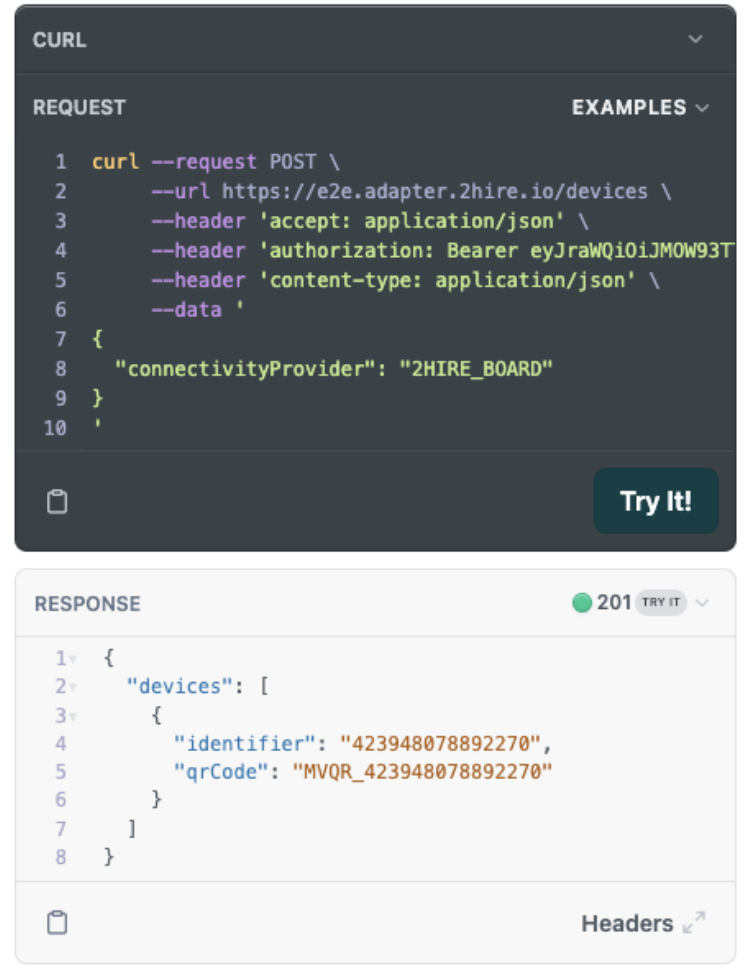
As already mentioned, the response will provide the list of device IDs to be used in the registration endpoint. Specifically, for the 2hireBox mock, you need to retrieve the QR code.
Additionally, to register a 2hireBox, you must specify a profile ID.
Please note that different connectivity providers may have additional required properties aside from the vehicle identifier, so make sure to check any specific integration requirements.
To quickly obtain a profile ID suitable for testing purposes, you can use the public profile list endpoint.
Once you have both the QR code and profile ID, you can proceed with registering the mock vehicle in the test environment.

Next, we will integrate the generic commands exposed by Adapter, namely the Start, Stop, and Locate commands. We will focus on the start and stop commands as they are the fundamental commands for controlling the vehicle and are intuitively used to initiate or conclude a trip.
Depending on the vehicle model, the start command will execute the necessary procedures to enable the user to access the vehicle and start driving. Adapter takes care of all the required work to prepare the vehicle for the trip, so it is transparent to you. The same applies to the stop command, which handles all the necessary actions to conclude the trip and shut down the vehicle.
It is important to implement proper error handling on your side. Commands may fail for various reasons, and your application should react based on your own business logic. In our Developer Portal, you will find a comprehensive list of status codes and error messages that may arise from each command. We provide standardized error codes, but there will always be a cause field specified in the response.
We encourage you to extensively test different scenarios by changing the vehicle status through the E2E test suite to observe the generated responses.
After successfully completing the integration and testing phase, you are ready to transition to the production environment. This involves checking eligibility for production, registering your vehicles in the live system, and utilizing the full suite of 2hire Adapter functionalities. You can test each endpoint beforehand using our Developer Portal.
The authentication process in production is the same as in the Test suite. However, you will need to obtain your production credentials from your business referent.
Once your vehicles are deemed eligible, you can proceed with the registration process in the live system. Make sure to gather all the necessary information for registering your vehicles based on the selected connectivity provider, ensuring a smooth registration without any delays. You can find all the details in the Developer Portal.
Once registered, you can start interacting with your real vehicles through Adapter’s functionalities, including data exposure and command forwarding, which were developed using the Test suite.
Congratulations! You have successfully integrated the Adapter generic commands into your car rental or peer-to-peer car sharing platform. Now you can implement your own business logic while leaving the “hard work” of interacting with your vehicles to Adapter. With just one integration, you can connect, manage, and control various vehicles from different manufacturers, as long as they are compatible with our service. How cool is that?
Stay tuned for the next installment in this series, where we will delve deeper into the advanced features and customization options offered by 2hire Adapter.

Senior Engineer at 2hire
Computer engineer with a passion for art. When not coding, you may find me painting, reading, binge-watching tv shows, or, most probably, sleeping.
Posted on July 19, 2023 by Benedetta Biggi
16 Mar 2023 | 4 min read
Contactless rental is not only a wise choice for the car rental operator, but also for the customer. When we speak about contactless rental we mean a software solution to digitize and automate a car rental business. A digital rental model enables time-saving, operational costs optimization, and efficient fleet management for a premium car rental experience.
The car rental market is becoming more competitive and is quickly sliding into the world of fleet digitization. Car rental companies must grab the opportunity here since the 25-45 years old age group represents 75% of the rental market and are more willing to pay a plus price for a digital and immediate experience.
In the article on the advantages for the car rental operator, we set out the carousel of reasons (benefits, rather than reasons) why a car rental business should go digital. But we do not want to stop there, today we showcase another vital side: the user experience.
Today’s user seeks immediacy and convenience in booking and picking up their rental car. Choosing a contactless rental gathers all these needs and generates 2.0 benefits that a traditional car rental could never provide. Let’s see them together!

Choosing a contactless car rental over a traditional one can offer significant time savings. With contactless car rentals, car keys are often directly inside the connected car, making them ready to be picked up with just a few clicks from the renter’s phone. This not only eliminates the need to wait in line at a rental desk but also drastically cuts off time to complete paperwork in order to pick up the keys. Additionally, the choice of a contactless rental can greatly reduce the amount of paperwork required, including ID, driver’s license, and contract signatures.
With the convenience of technology, renters can save valuable time and streamline their user car rental process, allowing them to get on the road quickly and easily.
With a contactless rental, contactless vehicle access can be done in a much more distributed manner across the territory. The end user will be able to use the GPS location to go to the car or even have it delivered near him/her.
The ability to rent a vehicle 24/7 is a significant advantage for the end user when it comes to choosing a contactless car rental with connected vehicles. Unlike traditional car rental companies, which typically operate on fixed business hours, a connected fleet allows for digital management of operations. It provides users with access to their car rental vehicle at any time of the day or night 365 days a year. With digital management, car rental companies allow remote control of their vehicles. Furthermore digital car rental companies allow users to access their booked cars without the need for physical interactions with other people or at the front office. Thanks to a contactless rental model digital pick up and drop off is made possible. The 24/7/365 access allows for unlocking and locking of the vehicle. The retrieval and return of the keys is also managed digitally.
This not only provides greater flexibility and convenience for the end user but also streamlines the car rental process, reducing wait times and minimizing the potential for errors or delays.
When it comes to renting a car, one of the most tedious tasks is keeping track of the mileage. From remembering the initial mileage at pick-up to ensuring that you don’t exceed the allotted kilometers, it can be a hassle to keep track of it all. However, with more and more connected cars in rental fleets, this task is becoming a thing of the past.
For the end user, this means that the car is equipped with an odometer feature and GPS tracking. These components automatically record the car’s trip and distance traveled. In this way there’s no need for the user to manually enter the kilometers at pick-up and drop-off. Surely the chances of errors or disputes over mileage is extremely reduced.
In addition to the time savings, another advantage of choosing a contactless car rental is that the specific car model and features are often guaranteed.
When renting a traditional car, it is possible that the desired make or model may not be available, leading to disappointment or the need to make last-minute adjustments. With contactless car rentals, once you book a connected rental car, you will receive a direct reservation to that specific vehicle that includes contactless rental. This ensures that you will no longer have to worry about any unforeseen timing issues due to vehicle availability. Additionally, you simply have to go straight to the car without going through a front office, the place where more often the unexpected car change occurs.
With the use and availability of safety features such as GPS tracking, DTC (Diagnostic Trouble Code for car issues identification), service alerts for car maintenance, odometer, and many more, car rental companies can have a better understanding of the condition and usage of their vehicles. This can lead to more accurate maintenance and repair schedules, ultimately resulting in a better car rental experience for the end user.
Opting for a contactless car rental can provide clients with significant advantages, particularly when it comes to car insurance based on driving behavior. With the availability of connected cars in contactless rentals, driving behavior can be tracked and analyzed in real-time. This advantage allows for customized insurance premiums that accurately reflect the individual driver’s risk profile. By driving safely and responsibly, clients can demonstrate a low-risk driving pattern and potentially qualify for lower insurance rates. This also promotes safer driving habits and helps reduce the overall risk of accidents on the road.
A carmaker example of this driving behavior-based insurance is Tesla. Tesla, based on user driving behavior, offers clients different insurance plans. If you are a “careful” driver you pay less than a more “witty” driver.
Many insurance companies are starting to use black boxes to do this kind of analysis on their customers to tailor their offers based on different driving profiles. By choosing a connected car with these specific features, clients can enjoy a more environmentally-friendly and cost-effective driving experience.
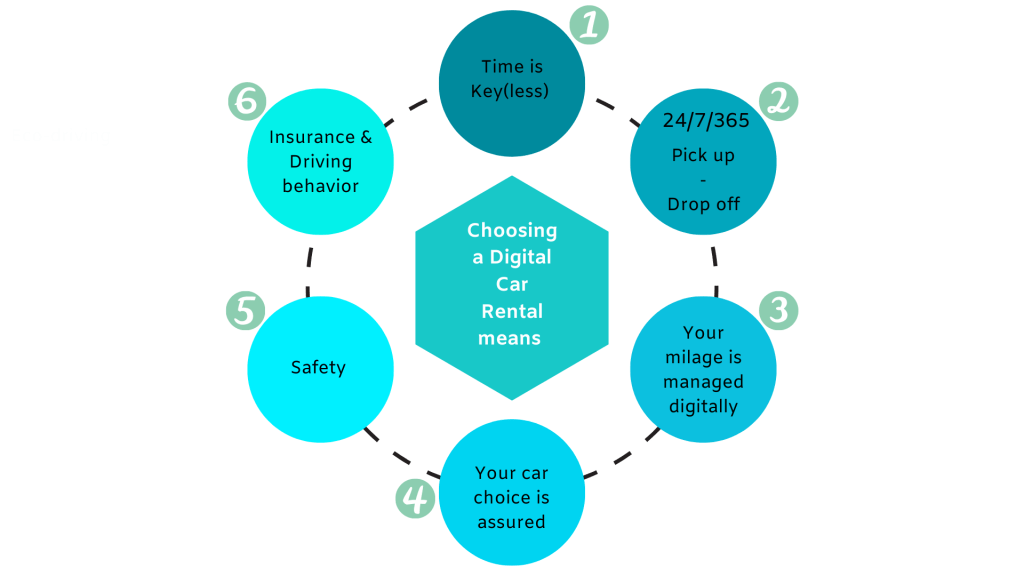
Based on the topics covered in the first two articles, by leveraging cutting-edge technologies, the car rental operators on one side are poised to remain at the forefront of innovation and continue to meet the evolving needs of their customers in the years to come. On the other side, choosing a contactless rental for the customer is the go-to for having the desired amenities only a click away. Whether you’re a frequent traveler, a busy professional, or just looking for a better way to rent a car, a contactless rental is the go-to!
Stay tuned for the next episode where we will talk about…
Digital Content and PR Specialist at 2hire
I love running and daydreaming losing count of the distance I’m covering, cooking (and especially eating) and Drake is my spirit guide.
Posted on March 6, 2023 by Benedetta Biggi
05 Sep 2022 | 3 min read
“The multiple launches of e-bike services reveal that the shared micromobility market is maturing.” – Fluctuo
Cities around the world are seeing a shift in the way people are getting around. With the covid-19 recovery, e-bikes sales in Europe and US reached the highest peak ever recorded. E-bike sharing is becoming more and more popular, it is one of the quickest, green, and most efficient ways to get around town. In this article, we will take a closer look at the e-bike sharing trend growth.
E-bike sharing is a system where e-bikes are made available for short-term use.
These services, which can be either provided by municipalities or by private corporations, require users to return the e-bike to a designated station (station based model), while others allow users to leave the e-bike anywhere within the service area, (free floating model). The e-bikes wave is increasingly spreading around big and small cities since they provide power assistance to the rider, making it easier to pedal over long distances while producing, in its small way, a green impact.
There are many reasons why bike sharing is becoming popular in cities. Firstly, e-bike sharing is a sustainable mode of transportation. E-bikes produce zero emissions, which is good for both the environment and public health.
Additionally, e-bikes services made riding to work and living the city way more comfortable and cheaper rather than owning and maintaining a private vehicle. And also cheaper than other modes of transportation, such as taking a taxi or Uber.
E-bike sharing works as a more flexible form of public transport (and with public transport too), which is perfect for those who don’t have, or don’t want, a car.
These benefits have been compounded by the social distancing needs of the pandemic. Biking is a great way to get around while still maintaining a safe distance from others.
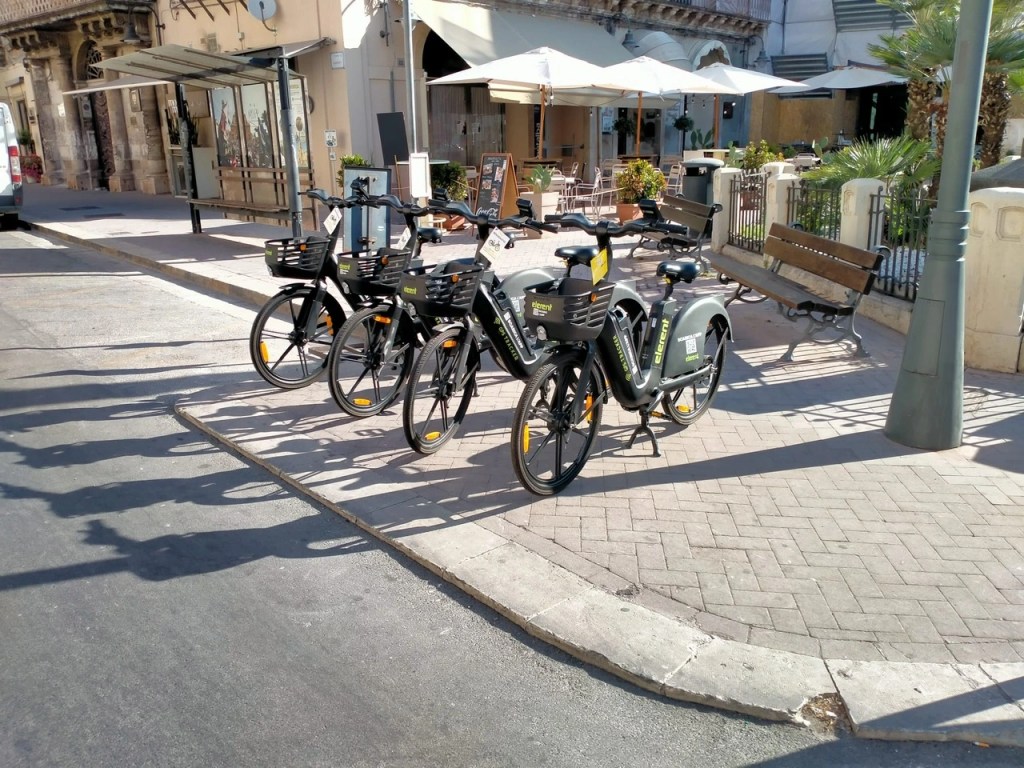
The global e-bike sharing market was valued at $3.43 billion in 2019, but its recent rise in popularity means it is projected to reach $6.98 billion by 2027, registering a CAGR of 14.0% from 2020 to 2027.
Italian glimpse 👀🇮🇹🚲
E-bike sharing has experienced a boom in Italy.
E-bike sharing is the most popular sharing mobility service in Italy, around 2.5 million Italians used an e-bike sharing service in 2021, and together with scooters, it is the service that has shown the most marked upturn once the lockdown period ended.
The number of available e-bikes in Italy has tripled since 2015, and currently, 265 municipalities and other local authorities have e-bike sharing schemes active, the overall number of shared bikes in Italy is 39,500.
What is clear is that bike sharing is riding the wave to get around cities, with the number of e-bike sharing schemes and available e-bikes continuing to pop up around.

This is partly due to the fact that electric bikes make cycling easier and more accessible for a wider range of people, including those who do not need to travel long distances, but still want to make the most of the convenience and swiftness of such a service.
The coverage in Italy goes from the top to the heel, from Milan to Venice, from Rome to Naples, and Sicily. It’s easier to say that in every region you visit, there is sure to be an e-bike at your disposal!
A gaze at Europe 🇪🇺
Europe alone hosts 41% of all bike sharing services.
Several European operators have launched e-bike sharing services to jump into 2022 with a head start and more than 13,000 new free floating e-bikes have hit the streets of Europe just in the last six months.
In 2020, the market of e-bikes in Europe had an estimated value of $8.01 billion. The projection for 2026 is $16.58 billion.
Clearly, the benefits of such vehicles have played a major role in the popularity of e-bikes sharing around. The acknowledged benefits are:
With the rapid rise in market value, more and more e-bike sharing schemes are likely to spring up in the coming years. This is good news for those of us who want to see more sustainable, emission-free transportation options made available to the public, not only in big city centers, but also suburban areas with lack of efficient transportation.
E-bike sharing comes with: inclusivity in enabling connection between city centers and surrounding areas and relieving traffic jams while facilitating transport for citizens.
With this data and facts at hand, we can say that e-bike sharing is here to stay, and its spread shows no signs of weakening 🚀
Sales and Marketing Associate at 2hire
I love running and daydreaming losing count of the distance I’m covering, cooking (and especially eating) and Drake is my spirit guide.
Posted on July 27, 2022 by Benedetta Biggi
14 Jul 2022 | 4 min read
In the big city, getting around is very often a cause of stress. Traffic jams, scarce parking, and long walks from public transport stop to your final destination can make even the simplest journey a true ordeal.
But what if there was an easier way?
Shared mobility offers you smart urban transportation that is tailored to your needs. Whether you need a ride for a few blocks or want to use a shared bike for your whole commute, sharing operators have got you covered!
Shared mobility is the most modern way of getting around cities using non-owned vehicles. You can choose from a variety of modes of transport, including cars, bikes, scooters, mopeds and more!
Shared mobility services are operated by mobility providers that can offer a single-vehicle or multi-vehicle fleet at your disposal, with a free-floating or a station-based type of service. To use such services, you simply need to download the operator’s app and create an account. Once you’ve found the vehicle you want to use, you can unlock it with your phone and away you go!
There are many benefits to using shared mobility services. Firstly, they can save you time and money. Commuters can avoid the hassle of owning and parking a car, and business travelers can save on expensive taxi fares.
Secondly, shared mobility services are more environmentally friendly than traditional modes of transport. They help to reduce traffic congestion and pollution in cities, and can even help you to be more active!
And finally, they offer you the flexibility to choose the right means of transport for your needs at any given moment. Whether you need a car to reach a restaurant far from your area, or an e-bike to cycle to work, there is always a shared mobility option ready to solve your problems.

There is a range of shared mobility vehicles available, including electric bicycles, cars, scooters, mopeds, and quadricycles. You can find shared mobility services in cities all over the world, so there’s sure to be something to suit your needs.
The most common and popular vehicles include:
Car ownership is not for everyone. It can be expensive and time-consuming, especially if you live in an urban area. Car sharing allows you to use a car when you need it, without the hassle of ownership.
For example, the Enjoy fleet of Fiat 500 Hybrid cars and Fiat Doblò vans available to drive in Turin, Italy, can be rented by the minute, hour, or day. This allows you to use a car for short trips around the city.
The company has also expanded its fleet with XEV YOYO electric quadricycles to allow for a greener, more sustainable form of transport.
Shared bicycles are a great way to get around cities. They’re usually cheaper and definitely faster than public buses, for example, and you don’t have to stress out about finding a parking spot since most of the time they are free floating.
Bike-sharing schemes are popping up all over the world. According to the latest Fluctuo European Shared Mobility Index, free floating bike trips are up 143% from Q1 2021.
Some highlights from the european landscape:
– Rome: RideMovi launched a fleet of 2,000 e-bikes
– London: Dott & Human Forest launched e-bikes in Hammersmith & Fulham
– Netherlands: GoSharing expanded in several dutch cities with e-bikes.
Another popular form of shared mobility for your free floating or station based service is the scooter. Their dynamicity is ideal for those who don’t want to hassle with parking in city centers!
There are several scooter-sharing businesses available, such as Bird, Lime, and Spin. Elerent is one of them. Starting from many cities around Italy, it has recently entered the foreign market with a new, scooter sharing solution around Greece!
Mopeds are going pretty well too. Just in the last 12 months, a total of +12,000 shared mopeds have been put on streets worldwide.
One of the latest examples is GO Sharing, which made 500 Supersoco CUX mopeds available in the Italian capital with a free floating model around the city. This is the first step toward a bigger scenario, since they affirmed they want to triple the sharing fleet in Rome to 1,500 e-mopeds by the end of the year.

Shared mobility is spreading like wildfire. With innovation and new technology, shared mobility is becoming more and more convenient, smart, and popular all around.
The latest data from the National Observatory on Sharing Mobility states that just in Italy there are 5,600,000 subscriptions to shared mobility services and 158 active sharing services. Today, 49 cities offer shared mobility solutions to their citizens: three times as many as in 2015.
All these options popping up are giving citizens the opportunity to indulge in the way they move around the city. Freely.
Sales and Marketing Associate at 2hire
I love running and daydreaming losing count of the distance I’m covering, cooking (and especially eating) and Drake is my spirit guide.
Posted on June 24, 2022 by Benedetta Biggi
7 Apr 2022 | 4 min read
Sharing mobility is a whole world.
Starting a new service of sharing mobility is tough.
You have to choose what kind of fleet you want (mopeds, kicks, scooters, bikes, cars… or a mix of them).
You have to choose what kind of the selected type of vehicles you want (NIU, SuperSoco, and so on).
You have to choose a provider for the connectivity of your fleet.
You have to choose the name of the service, its colors, the app.
You have to choose. A lot.
Even when everything above is set, you have to answer the million-dollar question. How many vehicles do you need for your service?
The decision is crucial to the fortunes of your service, and still, there is no clear answer.
Why?
Because they will tell you that every city is different. Every country is different. Every person has habits, rules, timetables.
Well, guess what.
It’s a lie, and this article is all about this.
From our experience as 2hire, we found a rule which helps you to answer the most difficult question you will ever face in the starting process of a mobility service: how you choose the number of vehicles in your fleet.

Finding a rule that fits different cities, with different climates, and different habits is not an easy process. In the summer of 2021, however, at 2hire, we had the opportunity to observe a single service act across multiple cities. The Elerent service has been active in almost 30 cities in Italy, from North to South, from East to West, from the mountains of Abruzzo to the seaside resorts of Sicily, Sardinia, and Puglia. The dataset lends itself to analysis for many reasons, but one of the things that makes it so valuable is that each site uses the same app, with similar costs for end-users. Often, when comparing different services, too much diversity in user experience can lead to lost value in the analysis. This is not the case here.
For each city, for each day in August, the following variables were selected as variables:
At the end of the month, for each city, the information collected contained:
As expected, these numbers are not comparable with each other: it would be wrong to compare the earnings of a city with a fleet of 60 vehicles with those of a fleet of 10. The same goes for the number of trips, users, or active vehicles. What is needed is a different measure, generated by putting together more than one of the metrics above.
Our analysis considered the Net Profit per Trip (NPT), calculated as the algebraic sum of profits, minus some fixed costs such as operational costs, IoT provider, and so on.
A sharing service will have to sustain other costs, but they will generally be costs that will impact with the same proportion all the earnings and that, for now, we can exclude.
We put the four standard quantities (revenues, fleet size, number of active users, and number of trips) in a correlation matrix with the Net Profit per Trip. The goal is to understand if the NPT is valid as a control metric. A correlation matrix is a tool for understanding whether quantities are in any way proportional to each other. The higher the correlation between two variables, the closer to 1 is the value. If two metrics are not correlated, the corresponding number on the matrix tends to be -1.
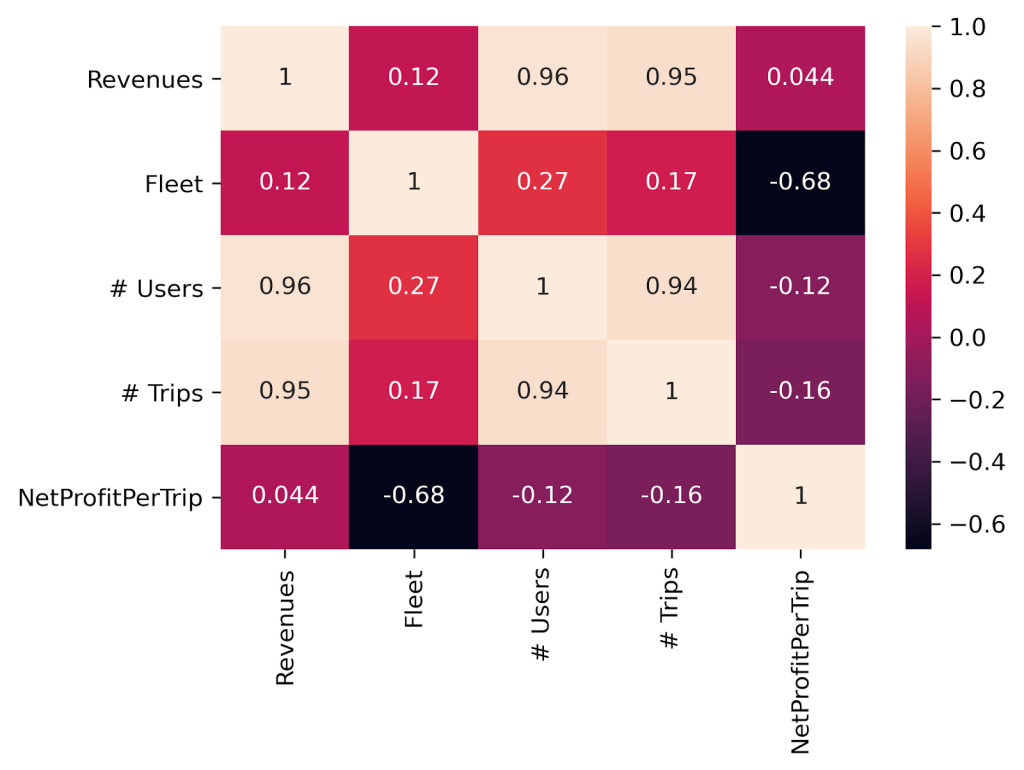
As you can see, the Net Profit per Trip is not correlated with the other quantities, which are strongly related to each other as expected.
This means that Net Profit per Trip is a good informative metric, and since it is independent of fleet size, the number of active users, trips, and revenues that are made in a city, it must depend on some external factor (such as the average trip duration, which maybe depends on the size of the geofence, or the habits of the inhabitants of that particular city).
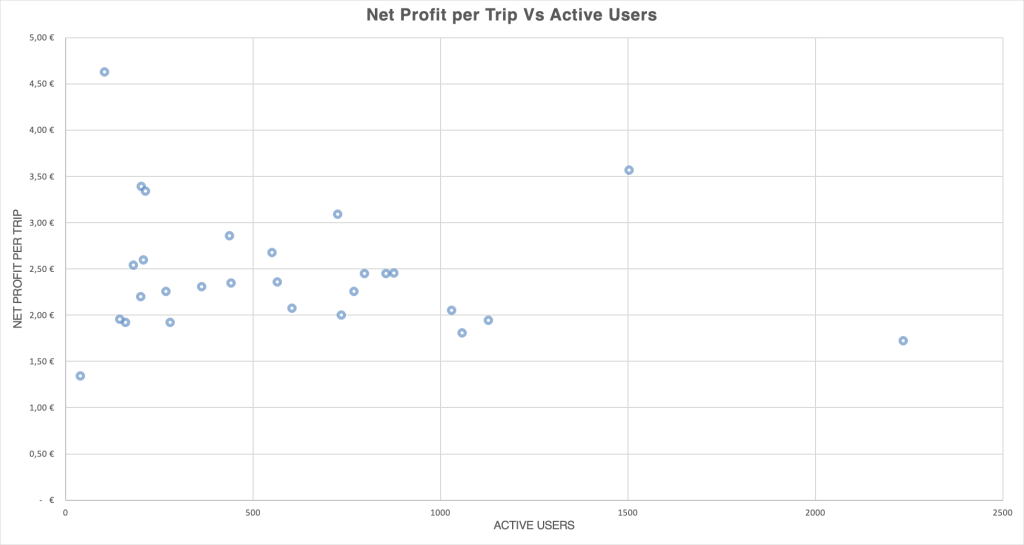
We know that Net Profit per Trip is independent of other quantities, and we can estimate it around 2.5€ per trip, according to the dataset we analyzed (graph) and the estimation previously made. So, this number can change according to possible fixed costs variations, and it is not intended as specific for the use case.
We know that fleet and users are correlated, as well as users and trips, as shown in the figures below
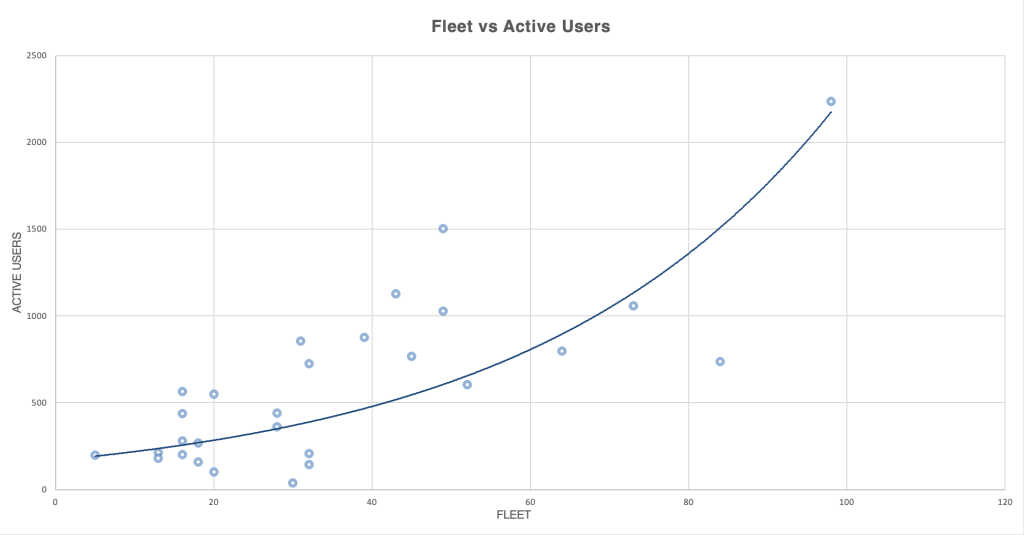
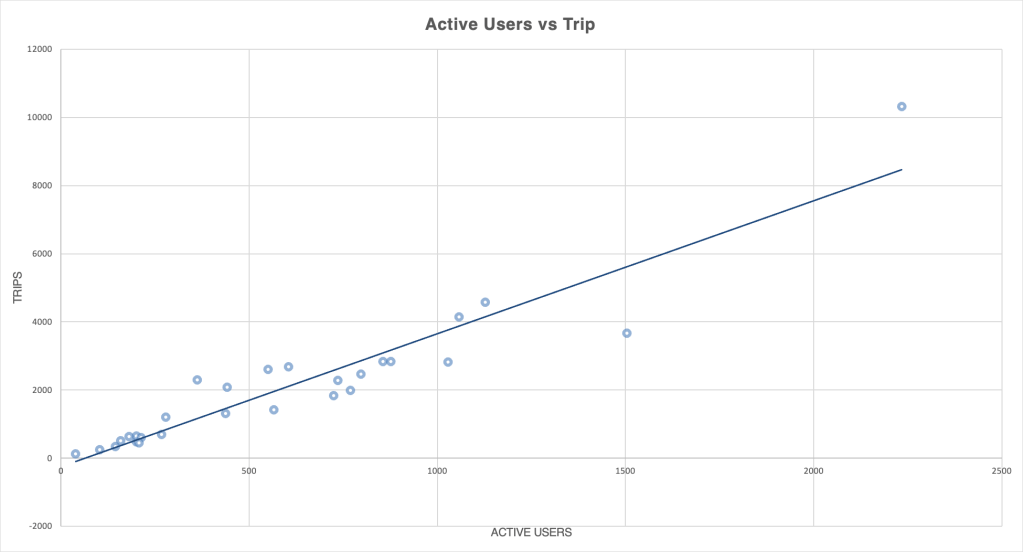
The Net Profit per Trip is crucial to start a sharing service because it can be used as a starting point to calculate the number of vehicles needed for the service to have a certain amount of monthly gain.
For example, suppose you want to earn 10K€ per month (Net Profit).
We know that the number of trips needed can be evaluated starting from the Net Profit, divided by the NPT, so 10000/2.5 = 4000 trips.
From figure 4, we know that for 4000 trips are needed about 1100 users, which according to figure 3 are obtained with about 60-70 vehicles.
Nothing more than that.
This is not as random as it sometimes seems. You just have to know how to read the numbers
All this needs to be parameterized and scaled, considering that the analysis looks at the month with the most trips in the year, but it is the information that the analysis contains that is crucial, much more than the final numerical result. Finding a rule that can give our customers an idea of how many vehicles they need, answering the million-dollar question that no one ever answers.

Data Scientist at 2hire
Less is more. I look for science and numbers in all my interests and emotions with the people I surround myself with.
Posted on April 7, 2022 by Benedetta Biggi